Bethlehem STACKS: the modular two-stage surface-mix bench torch
Bethlehem STACKS · Bench torch · Surface mix
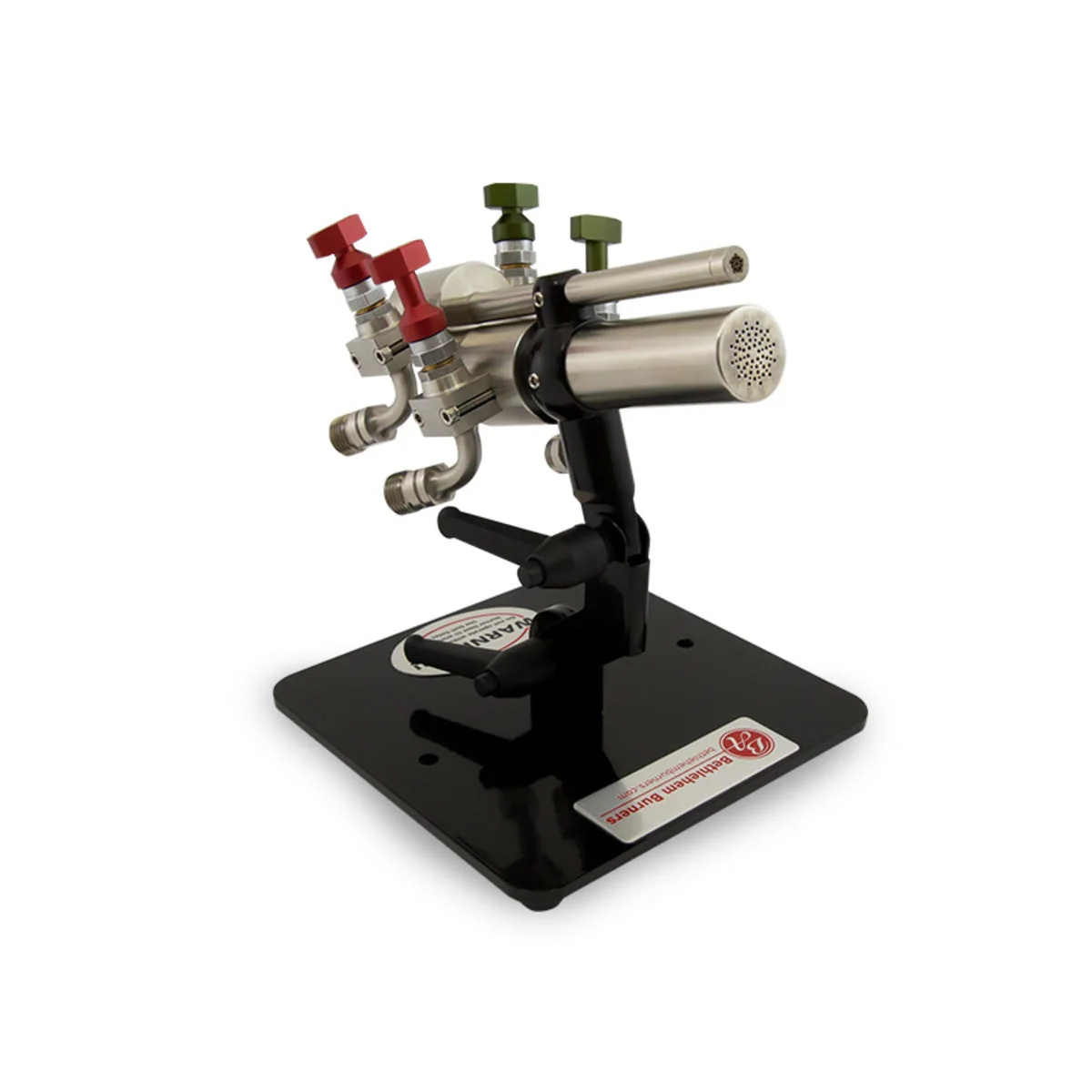
The Bethlehem STACKS is a two-stage surface-mix bench burner designed to fill the gap between the Alpha and Bravo — sold as Top Mount and Bottom Mount sections you can buy in stages, and friendly to oxygen concentrators.
Specs
- Mix type
- Surface mix
- Mount
- Bench
- Oxygen
- 10–20 LPM
- Fuel
- Propane, Natural gas
- Skill level
- Beginner, Intermediate
- Glass
- Soft, Boro
- Best for
- Beads, Soft glass, Boro
- Price
- Mid ($$) $$
- Stages
- 2
Overview
The Bethlehem STACKS is a two-stage surface-mix bench burner built to fill the gap between the Alpha and the Bravo. Its defining trait is modularity: it’s sold as a Top Mount and a Bottom Mount that can be bought in stages, so you can start small and add heat later. Like the rest of the line, it runs a quiet surface-mix flame and plays well with oxygen concentrators.
What the surface-mix flame gives you
The STACKS is surface-mix: fuel and oxygen meet at the face of the torch rather than premixing inside it, for the quiet, calm, low-backfire flame Bethlehem is known for. For the background on why that design is prized, see surface mix vs premix torches.
A torch you can build in stages
The two sections are designed to be bought separately and combined:
- STACKS I (Top Mount): a 6-jet sharp-flame fire on a 0.375in face. At full flame it draws roughly 2 LPM gas and 10 LPM oxygen — a small, focused flame for detail.
- STACKS II (Bottom Mount): an 18-jet fire with 48 oxygen ports on a 1in face. At full flame it draws roughly 4 LPM gas and 20 LPM oxygen — the broader soaking flame.
Run together, you get a two-stage burner that spans fine detail to medium soaking heat; bought one at a time, you can grow into it as your work and oxygen supply expand.
Glass, fuel, and oxygen
The STACKS handles beads, soft glass, and small boro and burns propane or natural gas with oxygen. Bethlehem notes it works well with oxygen concentrators, which fits its place in the line — but be realistic about scale: the bottom fire wants around 20 LPM at full flame, more than a single small concentrator delivers, so size your oxygen to the flame you actually run. See how many LPM does my torch need and oxygen concentrator vs tanks.
The hardware advantage
Like the rest of the line, the STACKS carries Bethlehem’s signature swivel and rack-and-pinion adjustment, so you can set a precise, repeatable angle and height — a real comfort over long sessions.
Where it sits in the Bethlehem lineup
The STACKS is the bridge between the entry Alpha and Star and the two-stage Bravo and Champion. Its build-in-stages design makes it a flexible on-ramp for someone who wants to grow within the brand. Compare the surrounding tiers in Alpha vs Bravo vs Champion.
Before you buy
Budget for the whole system, not just the torch: oxygen (a concentrator or tanks), the correct propane or natural-gas regulator, flashback arrestors on both lines, didymium eyewear, and ventilation. New to plumbing a torch? Start with the fittings, hoses & connectors guide and the glass torch safety setup guide.
Editor’s note: flame and flow figures above reflect Bethlehem’s own catalog for the STACKS sections. Bethlehem doesn’t publish current pricing, so confirm that — and how the staged sections are configured for your work — with Bethlehem before purchasing.
Best for: Beginners and intermediates doing beads, soft glass, and small boro who want a quiet surface-mix flame they can build up in stages and run on a concentrator.
Not for: Large boro tubes, thick solid work, or production heat — step up to a Champion or multi-stage Grand for that.
Pros
- + Quiet surface-mix flame in the Bethlehem tradition
- + Modular: Top Mount and Bottom Mount sections can be bought in stages
- + STACKS I (top) is a 6-jet sharp-flame fire on a 0.375in face; STACKS II (bottom) is an 18-jet fire with 48 oxygen ports on a 1in face
- + Works well with oxygen concentrators
- + Handles soft glass and small boro
Cons
- − Not built for large boro or production-scale heat
- − Full two-stage flame wants more oxygen (~20 LPM bottom fire) than one small concentrator delivers
- − Premium mounting hardware is part of the price
Flame notes
Stainless surface-mix bench burner designed to fill the gap between the Alpha and Bravo; sold as Top Mount and Bottom Mount that can be bought in stages. STACKS I (top) has 6 sharp-flame jets on a 0.375in face (~2 LPM gas / 10 LPM oxygen at full flame); STACKS II (bottom) has 18 jets and 48 oxygen ports on a 1in face (~4 LPM gas / 20 LPM oxygen). Works well with oxygen concentrators.
Maker
Bethlehem Burners
USA
Focus: Scientific, Production, Boro
Alpha/Bravo/Champion/Grand Brander/PM2D and larger production burners; premix.
Related reading
- Bethlehem Alpha vs Bravo vs Champion: Which Bench Torch?
- Surface Mix vs Premix Torches: Which Is Right for You?
- Oxygen Concentrator vs Tanks for Lampworking: Which Supply Should You Run?
- How Many LPM Does My Torch Need? Sizing Oxygen for Your Glass Torch
- How to Choose a Glass Torch: The Complete Buyer's Guide
FAQ
- Where does the STACKS fit between the Alpha and Bravo?
- It's designed to fill exactly that gap. The Alpha is the entry single-stage burner and the Bravo is the compact two-stage; the STACKS gives a two-stage, build-in-stages option in between. See our Alpha vs Bravo vs Champion guide for the surrounding range.
- What does 'buy in stages' mean?
- The STACKS comes as a Top Mount (STACKS I) and a Bottom Mount (STACKS II) that can be purchased separately. STACKS I is a 6-jet sharp-flame fire on a 0.375in face; STACKS II is an 18-jet fire with 48 oxygen ports on a 1in face. You can start with one and add the other.
- Can the STACKS run on an oxygen concentrator?
- Yes — Bethlehem notes it works well with oxygen concentrators. At full flame the bottom fire wants around 20 LPM of oxygen, though, which is more than a single small concentrator delivers, so size your oxygen to the flame you run. See how many LPM does my torch need.
- Soft glass, boro, or both?
- Both. The STACKS handles beads, soft glass, and small boro; for larger tubes or thick work you'd step up the line.