Short answer: Matching COE numbers are useful for identifying a glass family, but they do not prove that two glasses will fit together after working and cooling. Compatibility also involves viscosity, the actual materials joined, and their heat history. Use a manufacturer’s tested system as your starting point, then evaluate the specific combination under conditions representative of your work.
Two rods marked 104 can produce a cracked bead. A piece made entirely from one compatible system can also crack. Those statements describe different problems, and the label alone cannot tell you which one happened.
The useful question is more precise than “Are these both the same COE?” Ask: which color and batch, joined to which reference glass, in what arrangement, after what treatment? That turns a frustrating failure into something you can investigate. It also explains why a manufacturer can stand behind its testing without promising that every imaginable construction will succeed.
What COE tells you, and what it leaves out
The coefficient of thermal expansion describes dimensional change with temperature. A published mean coefficient belongs to a stated temperature interval. A value measured over a low-temperature range does not describe everything the glass does as it passes through its transition region.
Bullseye’s TechNotes 3 explains why expansion alone cannot predict compatibility: viscosity matters as well. During cooling, glasses differ in how readily they can relax stress before becoming rigid. Their fit depends on these behaviors together, rather than on one printed number. [1]
This is why “same COE” and “tested compatible” should not be used as synonyms. It is also not permission to combine unrelated glass families. A technical explanation of why one number is incomplete does not establish a usable pairing between 33, 90, 96 and 104 materials.
For purchasing and storage, keep the intended systems distinct. For a finished piece, seek evidence about the actual glasses and process. The number is an identifier to investigate, not a substitute for that evidence.
A compatible system is more specific than a brand
Bullseye makes a useful distinction in its own FAQ. It describes compatibility through its tested product system rather than assigning its glass a “COE 90” specification. Its catalog also distinguishes products intended for fusing from products that are not. Buying two items carrying the same maker’s name is therefore not enough; their product designation matters. [2]
The same reading habit helps at a lampworking bench. Keep the complete identity: maker, color code, product form, lot information where supplied, and working notes. “A blue rod” cannot be traced back to a test statement. Neither can a bin of unlabeled shorts.
| Information on hand | What it helps establish | What remains unanswered |
|---|---|---|
| Nominal COE family | Where the material is intended to belong | Whether this particular pair has been tested |
| Maker and exact product code | Which instructions and specifications apply | Whether your batch and construction behave as expected |
| Named reference glass | What the maker actually compared against | Performance against every other color |
| Test method and heat history | The conditions behind the result | Behavior after a substantially different process |
| Your documented sample | Evidence for that sample and treatment | An unlimited guarantee for future work |
How glassmakers test fit
Double Helix: a reference glass and a measured seal
In Julie Hannay’s One Manufacturer’s Perspective on Compatibility, Double Helix describes testing melts with a trident seal against Effetre clear, annealing the sample and measuring strain with a polarimeter. The paper makes an important distinction between measuring expansion and measuring the fit of joined glasses. [3]
That is a historical account of the manufacturer’s method, not an independent audit of today’s production. Its value here is the structure of the test: identified reference, joined sample, controlled treatment and measurement. A nominal family label is only the beginning.
It also shows why “tested against Effetre clear” should be repeated accurately. It does not mean every Double Helix color was tested against every Effetre color in every proportion. Our Effetre and Double Helix compatibility guide addresses that particular pairing.
Creation is Messy: testing against real glasses
Creation is Messy describes using actual Effetre, Vetrofond and Lauscha clear reference glasses, rather than treating an abstract 104 value as the entire specification. Its process includes trident-seal testing of melts, polarimeter measurement and subsequent practical working tests. [4]
CiM also explains the limit: factory tests cannot duplicate every artist’s technique. Glass thickness, the arrangement of layers and the way a piece is worked affect the result. A maker’s practical tests and your studio tests answer related questions at different scales.
Heat history can change the question
A compatibility result belongs to a process. Bullseye’s What to Expect guidance explains that factory testing has defined conditions, while an artist may apply more heatwork through repeated firing or other processes. It specifically identifies torchworking as a process that can exceed the conditions represented by its standard kiln tests. [5]
Consider a small trial assembled quickly at the torch and a larger piece that is repeatedly reheated, encased and then fired again. Even when the rods came from the same bundle, those are different histories. A useful trial should represent the demanding parts of the intended process, not just demonstrate that the glasses can initially be joined.
Write down reworking and additional firings alongside the kiln program. “Annealed normally” is too vague to compare two outcomes, especially if the process changed between them.
A specific example: Bullseye Chartreuse
Bullseye’s working notes for Chartreuse 001126 connect appearance and treatment to a particular product. The rod can strike toward yellow-green, and the maker describes using limited heatwork when transparency is desired. The same product page cautions against extended heatwork in kilncasting because the glass can become incompatible. [7]
That warning should stay attached to the named glass and process. It does not mean every green glass behaves this way, or that an attractive color change proves a piece is compatible. It shows why color-specific working notes deserve to travel with a rod from storage to bench.
Bullseye’s separate guidance on cadmium-bearing glasses likewise calls for testing the actual material through the intended heatwork. In that specified context, changes such as a transparent glass becoming opalescent can accompany changed compatibility. Do not generalize that observation into a visual test for all glass. [6]
Annealing stress and compatibility stress are different
Annealing manages stresses created by temperature differences within a piece. Bullseye’s Heat & Glass notes explain the combination of temperature equalization and controlled cooling, with the requirements affected by dimensions, geometry and kiln conditions. A controller reaching its target does not instantly establish an even temperature throughout a thick or uneven object. [8]
A compatible combination can therefore fail after inadequate annealing. Conversely, a carefully controlled anneal does not change two formulations into a different pair of materials. Treating every crack as a request for a longer soak skips the question of fit.
For borosilicate, Northstar’s annealing guidance discusses variation among colors and the effects of construction, thickness changes, reheating and kiln conditions. It does not reduce every piece of nominal 33 glass to a single universal program. [9]
This matters when moving from a small bead to a hollow form with thick attachments, or from clear work to a heavily layered color construction. Keep the maker’s guidance and the actual geometry together when selecting a schedule. The annealing guide provides the broader framework; an individual color’s current instructions supply the more specific constraints.
Bullseye’s guidance on monitoring kiln temperatures adds another distinction: the temperature reported at one measuring point is not a complete map of the kiln. Its discussion of multiple measurements is especially relevant when larger work requires evidence that cooling is sufficiently uniform. [10]
What polarized light shows
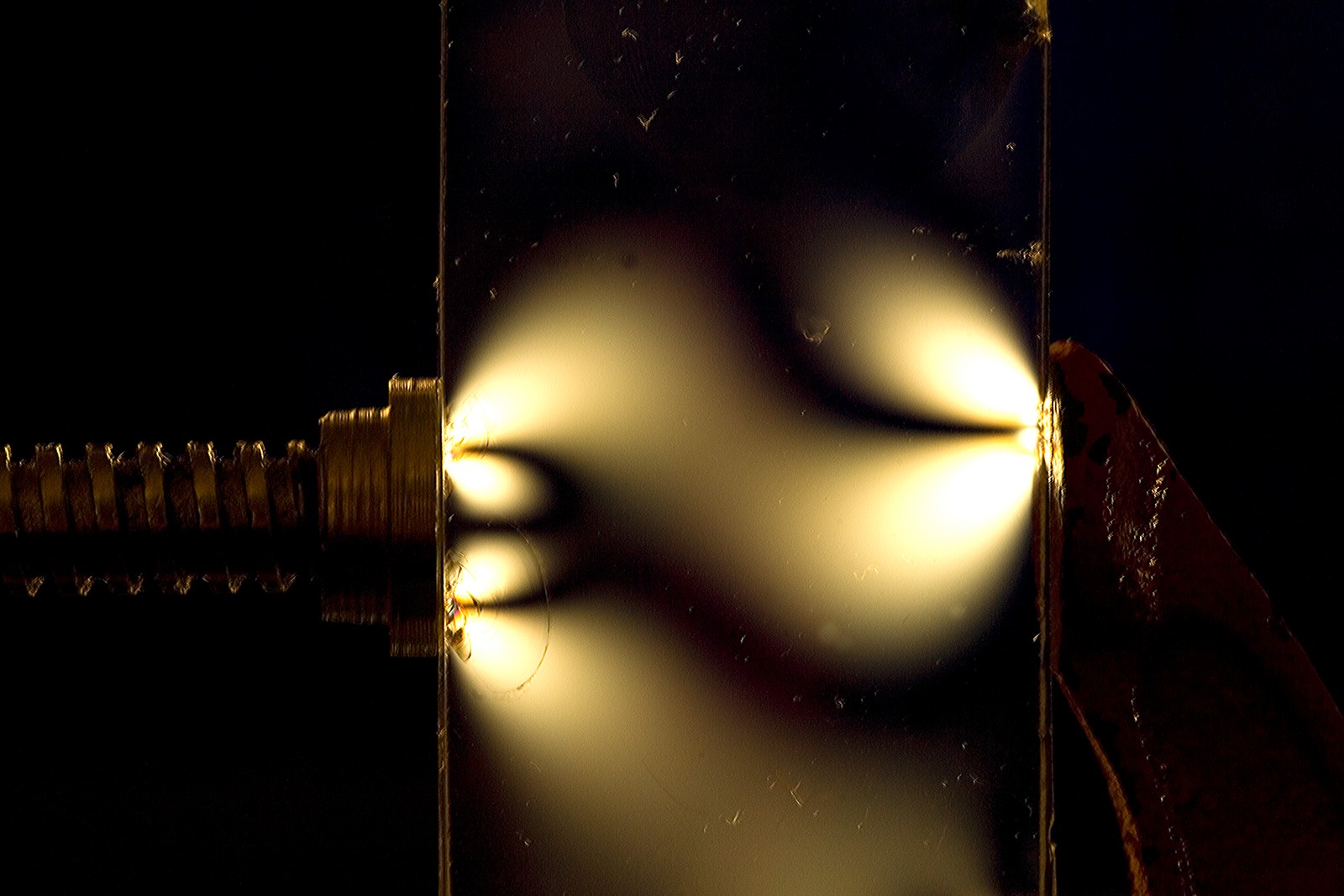


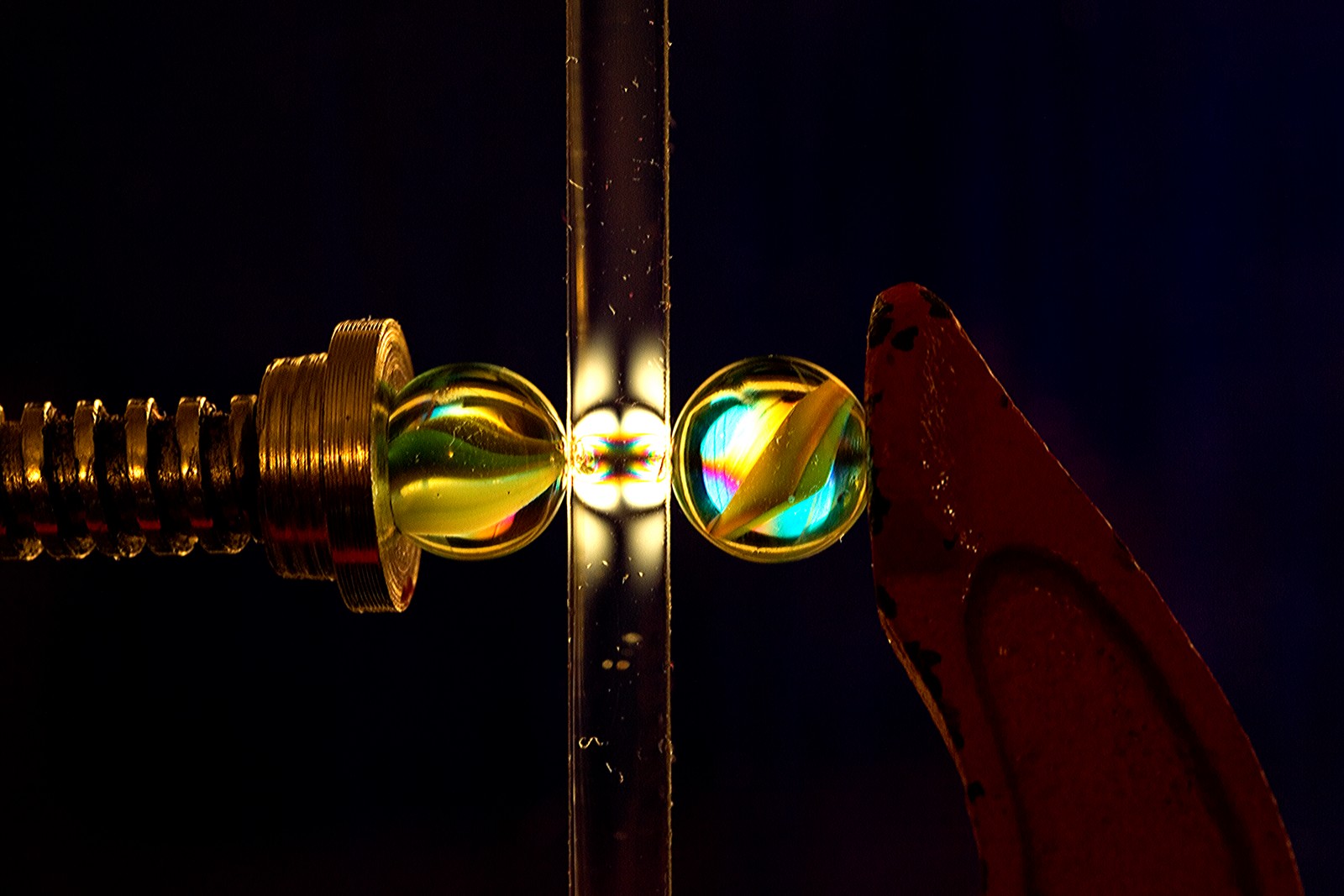
The University of Iowa’s optics demonstration uses stressed glass, including Prince Rupert’s drops, to show stress through crossed polarizers. Its apparatus also demonstrates stress in plastic. Neither demonstration requires two incompatible glasses fused together. [11]
That is the reason for choosing these photographs. The clamp supplies the load, making the distinction visible: a stress pattern is evidence of stress, while its cause needs a separate explanation. The photographs are not a calibrated color scale and are not samples of failed lampwork.
A home crossed-polarizer viewer is useful for examining a suitable transparent sample, but “I see no halo” is not a universal pass certificate. It does not reproduce a maker’s calibrated measurement, reference geometry or acceptance procedure. If you are learning to interpret the view, compare a documented reference and discuss ambiguous results with the glass manufacturer instead of assigning a numerical strain value from a photograph.
Make a sample that answers a real question
Before testing, write one sentence naming the uncertainty. For example: “Does this identified color, encased in this clear, show a repeatable problem after my planned reheat and anneal?” That is more actionable than “Is this brand good?”
Use the manufacturer’s testing guidance where supplied. The following is a record template, not a replacement test protocol or a firing schedule:
| Record | Include |
|---|---|
| Materials | Maker, product code, batch or purchase identity, reference clear |
| Construction | Sketch or photograph, proportions, layer order, thick and thin regions |
| Torch treatment | Relevant reheating, encasing and color-development steps |
| Kiln treatment | Actual program, additional firings, placement and unusual events |
| Observation | Crack location and timing, photograph, strain-viewing method |
| Comparison | What stayed the same and the one change being investigated |
Keep the sample with its record. If several variables change together, a better-looking result may be encouraging without telling you which change mattered. That distinction is useful when deciding whether to repeat the trial or commit substantial time to a finished piece.
When a piece cracks, investigate before choosing the fix
Start with identity. Confirm that every ingredient, including clear, frit and any dichroic carrier glass, belongs to the intended system. A coating’s color is not the identity of the glass underneath it; the dichroic guide explains that distinction.
Then reconstruct the treatment and construction. Did a new color coincide with thicker encasing? Did a successful small design become a much larger object? Was a second firing added? Those observations suggest useful comparisons; they do not prove a cause by themselves.
Finally, assemble evidence for the next decision. Product codes, photographs, sample records and the actual kiln program make a manufacturer conversation more productive than a brand name and a description of a crack. The cracking troubleshooting guide covers other failure modes that also need consideration.
The aim is a repeatable combination supported by identifiable materials and a documented process. That is a stronger basis for the next piece than matching numbers alone.
Related guides
- Effetre and Double Helix compatibility
- Clear borosilicate quality and brand differences
- Annealing schedules for glass
- Why did my glass crack?
- Dichroic glass in lampwork
- Using shorts and scrap glass: keeping leftover glass identified
- Frit application guide: testing an unfamiliar frit-and-base pair
Sources
- Bullseye Glass, TechNotes 3: Compatibility of Glasses. Expansion, viscosity and representative testing.
- Bullseye Glass, FAQ. Tested systems and fusible product designations.
- Julie Hannay, Double Helix Glassworks, One Manufacturer’s Perspective on Compatibility. Historical manufacturer account; document undated.
- Creation is Messy, Compatibility. Reference materials, melt tests and practical limits.
- Bullseye Glass, What to Expect from Bullseye Glass. Test conditions and additional heatwork.
- Bullseye Glass, Heatwork and Cadmium-Bearing Glass. Process-specific material changes.
- Bullseye Glass, Chartreuse 001126. Product-specific working notes.
- Bullseye Glass, TechNotes 4: Heat & Glass. Thermal behavior and annealing.
- Northstar Glassworks, Annealing. Borosilicate colors, construction and kiln conditions.
- Bullseye Glass, TechNotes 7: Monitoring Kiln Temperatures for Successful Annealing.
- University of Iowa, 6H35.50: Polarization, Stress on Plastic and Glass.
- Takislazos, stressed glass plate and plate with two marbles, 2013. Photographs licensed CC BY-SA 4.0; display copies proportionally reduced.