A bead enters the flame and its edges disappear inside a bright yellow-orange glow. Through the right sodium-flare filter, the shape becomes visible again. That change is the reason didymium glasses became a familiar part of the lampworking bench. It is also the source of a persistent misunderstanding: a lens that makes the flame comfortable to look at has not necessarily answered every eye-protection question.
Didymium describes a history of rare-earth glass, a recognizable filtering effect and, less precisely, a category of eyewear. Today’s sodium-flare lenses include glass and polycarbonate, single materials and layered constructions, light filters and darker combinations. Their color and trade names reveal much less than an identified lens specification and its transmission data.
This guide follows the filter from chemistry to the finished frame. It explains the charts, distinguishes old materials from current products, and examines Aura Lens Products’ historical designs. For choosing equipment, the current eyewear manufacturer’s instructions for the exact lens and frame take precedence. The studio safety checklist covers the wider setup; the detail here is what sits between your eyes and the work.
What didymium actually is
Didymium began as a mistaken element. Carl Mosander reported it in 1841, and chemists treated it as an element until Carl Auer von Welsbach separated it into praseodymium and neodymium in 1885. The Royal Society of Chemistry records that separation in its history of praseodymium. The older name survived, especially in descriptions of optical glass. [1]
In traditional didymium glass, rare-earth constituents are incorporated into the material. Their wavelength-selective absorption gives the glass a characteristic spectrum, with stronger absorption in some regions and greater transmission in others. A rose or violet appearance is the visible consequence of that uneven filtering. It is not a complete specification.
The terminology becomes less tidy at the bench. Traditional rose didymium, ACE glass and Phillips 202 are often discussed as though they were interchangeable names for a single recipe. Historical Phillips technical descriptions preserved by ILPI distinguish S-8801 rose didymium from S-8817 ACE. Current Phillips product naming is a separate piece of evidence. It does not prove that an old blank, a vintage prescription lens and today’s finished glasses share an identical spectrum. [4, 12]
| Name on the bench | What it identifies | What still needs checking |
|---|---|---|
| Didymium | Historically, rare-earth filter glass; also a loose eyewear label | Exact material and finished lens |
| ACE | Amethyst Color Enhancement glass terminology | Glass code, thickness and product generation |
| Phillips 202 | A current Phillips glass-lens family | Current model instructions and spectral specification |
| Sodium Flare Polycarbonate | A polymer lens category | Formulation, additional filters and intended use |
| AUR / AGW | Historical Aura material or product designations | Exact code and dated documentation |
A filter can suppress sodium flare without containing traditional didymium glass. VetroSafe explicitly describes its lenses as didymium-free polycarbonate. That does not settle their suitability for a particular job, but it demonstrates why a material name and a filtering function must be kept separate. [21]
For the narrower naming comparison, see didymium versus ACE glasses. When identifying an actual pair, start with the maker and model rather than trying to infer its composition from its purple tint.
The sodium flare, and why it hides the work
The familiar flare is closely associated with sodium emission. NIST lists two strong neutral-sodium lines at 5889.950 and 5895.924 angstroms. Converting those values to nanometres gives 588.9950 and 589.5924 nm, the pair usually described as the sodium D lines near 589 nm. [2]
Those precise wavelengths matter when reading filter claims. A broad statement such as “blocks yellow light” does not describe how deeply a lens attenuates the sodium region. Equally, a reference to 585 nm in product copy should not replace the measured atomic line positions. A filter’s absorption band can cover a region; the sodium lines remain at their own wavelengths.
Selective filtering improves visibility by reducing the dominant glare while allowing other parts of the visible scene through. That can make the outline of a gather or the placement of a decoration easier to see. It also changes the balance of colors reaching the eye. The view is useful because selected wavelengths are suppressed, not because the lens reproduces an unaltered daylight scene.
Consider two separate questions at the torch: can you see the work clearly, and is the eyewear appropriate for the exposure? Clear visibility is essential for controlling the work. It is not a measurement of the ultraviolet or infrared reaching the eye. A photograph through a lens can demonstrate the first effect, but an ordinary camera image cannot certify the second.
The same caution applies to videos that make one filter look dramatically better than another. Camera exposure, white balance, lens angle and the glass in the flame can all influence the result. Useful demonstrations identify those conditions. They do not replace a spectrum or the manufacturer’s instructions.
What didymium filters, and what it does not
Sodium-flare suppression alone does not establish adequate infrared protection. That is more accurate than claiming that every lens called didymium transmits all infrared. Different materials have different spectra, and finished products may add dedicated infrared-absorbing elements. Aura’s historical composite lenses are a documented example. [5]
There are several questions to answer independently:
| Question | Evidence that answers it |
|---|---|
| Does the lens suppress sodium flare? | Transmission or optical-density data around the sodium lines |
| How much visible light remains? | Luminous transmission, shade information and the visible spectrum |
| What happens in the ultraviolet? | UV measurements over identified wavelength bands |
| What happens in the infrared? | IR measurements with the tested range and method stated |
| Does it provide required impact protection? | Documentation for the finished lens and frame assembly |
A product description that says “UV and IR protection” leaves considerable detail unspecified. Which wavelengths? Which test? Which lens? Is the result a band average, a maximum or a classification under a named standard? These distinctions become important when two apparently similar pairs perform differently.
Nor is visible radiation automatically harmless. In their research on glassworking installations, Oriowo, Chou and Cullen assessed optical-radiation exposure across different glass and heating conditions. Their findings support task-specific selection, rather than dividing the world into harmless visible light and hazardous invisible light. [23, 24]
Why the infrared question matters
Infrared is outside the visible range, so a comfortable-looking flame is an unreliable guide to it. The exposure question includes the heating system, the glass being worked, the hot area in view, viewing geometry and time. The studies above examined actual workplaces, where those conditions varied. They do not provide one universal shade prescription for every modern bench torch.
A better reading of the evidence is specific: identify the process, then match the documented eyewear to it. Do not use a favorable visible photograph, a familiar brand name or the absence of immediate discomfort as a substitute for that match.
Reading transmission charts
A transmission chart is a map of what passes through a sample at different wavelengths. Before comparing curves, identify the sample, the axes and the limits of the measurement. A graph without those details may look technical while answering very little.
Start with wavelength and transmission
The horizontal axis normally shows wavelength, commonly in nanometres. The vertical axis may show percent transmission, fractional transmission or optical density. For a transmission plot, a lower curve means less light passes through. For optical density, a higher curve means less light passes through.
A chart restricted to the visible region cannot establish performance across the infrared. Even a graph extending to 1,000 nm covers only part of the infrared region relevant to a broader assessment. Where the plotted line ends, the evidence ends. White space beyond it does not mean zero transmission.
Also distinguish internal transmission from total transmission. Internal transmission describes absorption within the material while excluding surface-reflection losses; total transmission includes those surface effects. SCHOTT’s optical-filter catalog explains the distinction. A raw-glass catalog curve and a measurement through finished spectacles may therefore be different kinds of result. [3]
Optical density uses a logarithmic scale
Optical density, abbreviated OD, expresses attenuation on a logarithmic scale. With transmission written as a fraction, the relationship is OD = -log10(T). Each increase of one OD unit reduces transmitted light by another factor of ten. These are mathematical relationships, not measurements of a particular brand. [3]
| Optical density | Fraction transmitted | Percent transmitted |
|---|---|---|
| OD 1 | 0.1 | 10% |
| OD 2 | 0.01 | 1% |
| OD 3 | 0.001 | 0.1% |
| OD 4 | 0.0001 | 0.01% |
| OD 5 | 0.00001 | 0.001% |
On a graph running from 0% to 100%, several of those values can appear to sit on the same baseline. A curve that looks like zero may conceal a large proportional difference. Conversely, a rounded table entry of 0.000% does not prove infinite optical density. The instrument’s sensitivity and the precision used to print the result still matter.
An OD claim also needs a wavelength. Strong attenuation at one part of a spectrum is not evidence of the same attenuation everywhere else. For sodium filtering, the question concerns the actual sodium region, not the highest OD value found anywhere on the chart.
Resolution can change what the curve appears to say
Didymium glass has long been useful in optical measurement because it has recognizable absorption features. A 1955 National Bureau of Standards circular discusses didymium filters and shows why the instrument’s spectral bandpass affects the apparent minima. It identifies Corning 5120 glass at a stated 3.0 mm thickness. [22]
The lesson for eyewear charts is practical. A coarse sample interval can pass over a narrow feature, and an instrument measuring a wider wavelength band can smooth it. A printed line joining widely spaced points is not proof that every wavelength between them was resolved equally well. Two charts require compatible measurement conditions before their fine details can be compared.
Thickness matters too. A glass code without thickness is incomplete when discussing absorption. A lens assembled from multiple filter elements is a different optical path from a single blank. Keep the sample description beside the graph instead of separating it into a footnote a reader will never find.
VLT describes brightness, not the entire filter
Visible light transmission, often abbreviated VLT, summarizes visible transmission using a defined weighting. It is not a statement that the same percentage passes at every visible wavelength. A selectively absorbing lens can have a deep sodium trough and much higher transmission elsewhere while producing one overall luminous-transmission result. [3]
Likewise, an infrared band result is not automatically the maximum transmission within that band. A low average can coexist with a local peak. When a source supplies both a summary figure and a spectrum, read them together.
Shade numbers and product names require similar care. A manufacturer’s model called “3.0” and a report assigning a welding-filter scale are not automatically interchangeable statements. Read the designation in its documented context before treating it as a cross-brand equivalence.
A worked example: VetroSafe report R21312
VetroSafe links report R21312 from its technology material. The report carries a 2022 copyright, names ANSI Z87.1:2020 and presents the following results. It is manufacturer-hosted evidence, not an independent GlassTorches laboratory test. [17, 18]
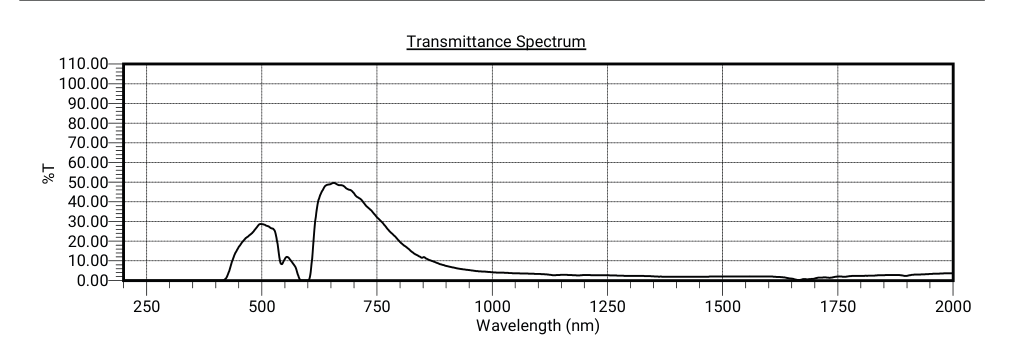
Figure 1. Transmission-plot excerpt from VetroSafe report R21312, copyright 2022 Proaxient Technologies LLC. The one-page report does not identify a specific frame/model, sample thickness, measurement date or instrument resolution. Its copyright year is not a stated test date. The plot does not establish performance beyond 2,000 nm.
| Report field | Printed result |
|---|---|
| Scale | W3.0 |
| Actual shade number | 2.86 |
| Luminous transmission | 15.87591% |
| T(IR), 780 to 2000 nm | 4.20094% |
| T(EFUV) and T(NUV) | 0.00000% displayed |
VetroSafe’s technology page claims OD5+ sodium suppression. The report’s sodium-region table prints 0.114% at 585 nm, 0.000% at 590 nm and 0.010% at 595 nm. Those 5 nm samples cannot, by themselves, resolve the attenuation at both exact sodium D lines or verify that OD5+ claim. The displayed UV zeros also require the usual rounding and instrument-floor caution. These limits concern what can be concluded from this report, not a finding that the product fails its stated purpose. VetroSafe’s FAQ also acknowledges situations in which a darker lens may be preferable. [17, 18, 20]
Glass lens or polycarbonate
Material choice affects weight, fabrication, surface care and how filters are combined. It does not replace a finished-product specification. The useful comparison is between identified lenses intended for the same job, not between “glass” and “plastic” as abstract categories.
Rare-earth filter glass
For absorbing optical glass, the composition creates the selective absorption. The optical blank is then made into a lens of the required shape and thickness. The finished article may receive coatings or be joined to another filter. SCHOTT’s catalog treats material properties, thickness and optical surfaces as distinct parts of the specification. [3]
That distinction explains why “the color is in the glass” is informative but incomplete. It identifies one filtering mechanism. It does not establish the condition of a decades-old lens, the integrity of a laminated assembly or the performance of an unidentified coating.
Phillips’s lampworking guidance describes its 202 glass and Sodium Flare Polycarbonate alternatives with different weight and durability trade-offs. Glass can be attractive where scratch resistance and optical properties are priorities; the polymer alternative can reduce weight. Those are practical reasons to compare them, alongside the actual protection required. [26]
Polymer filters
A polycarbonate filter can achieve selective absorption through a formulation rather than a rare-earth glass melt. A 1999 patent, US 5,922,246, describes synthetic-resin optical filters using organic dye and additional absorbing components, with polycarbonate among the named resins. It discusses molding, extrusion and added optical functions. [6]
That patent documents a manufacturing approach. It does not reveal the recipe of every present-day sodium-flare lens. Proprietary formulations should not be reconstructed from the words “didymium replacement,” nor should one manufacturer’s historical criticism of plastic be treated as test evidence against every modern polymer.
Prescription availability is also product-specific. Phillips’s Sodium Flare Poly replacement-lens page includes prescription options. That is enough to reject a blanket claim that polymer sodium-flare lenses cannot be prescription lenses. It does not mean every frame, power or filter combination is available. [16]
Coatings, laminates and separate segments
A coating can serve a surface-protection or optical purpose. A laminate joins separate elements with complementary transmission properties. A split lens places different filtering regions in different parts of the wearer’s view. These are different design choices, even when a finished pair combines more than one.
Oberon’s current Didymium Gold product illustrates the need for precise identification: the company describes a molded polycarbonate face shield with a gold surface and a scratch-resistant coating. It is a face shield, not a pair of ordinary lampworking spectacles. Its documented intended use must govern any comparison. [25]
For any layered system, the relevant evidence concerns the completed assembly. Choosing individually familiar parts does not automatically create a documented protective combination. Fit, optical quality, coverage and the manufacturer’s instructions remain part of the decision.
Aura Lens history
Aura Lens Products is closed. This section covers its historical eyewear and archived technical material.
Aura belongs in the didymium story because surviving primary documents show how it combined filters and how its maker explained those choices to glassworkers. The patent record and company writings are more useful than treating the name as either a current shopping recommendation or a vanished brand with nothing left to examine.
The documented composite-lens designs
US 6,612,697 B1 names Michael J. and Robert N. Aurelius as inventors and Aura Lens Products as assignee. Filed in 2001 and granted in 2003, it describes combinations built around S-8817-A ACE glass. AGW-186 adds infrared-absorbing glass; AGW-200 combines the base with green welding glass; AGW-286 brings the three elements together. The disclosed fabrication includes shaped components bonded with optical adhesive. [5]
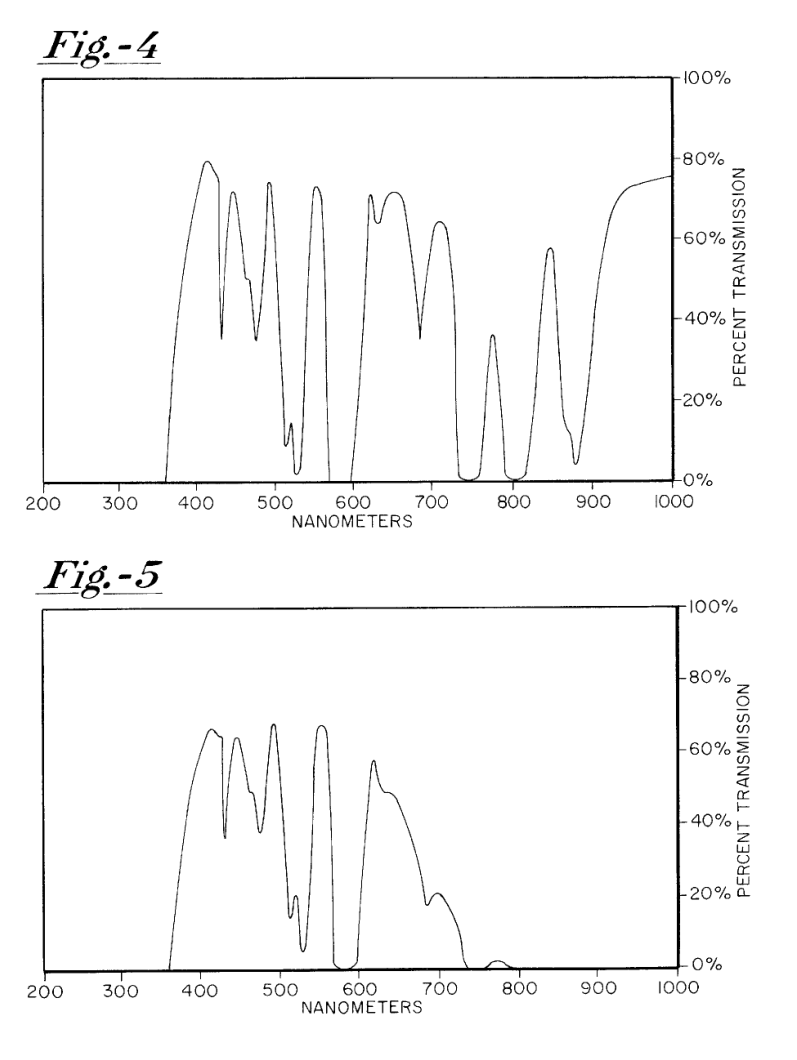
Figure 2. US 6,612,697 B1, Figures 4 and 5. The base-glass and composite plots illustrate different spectra. Both stop at 1,000 nm; neither describes all infrared wavelengths. Figure 6 elsewhere in the patent uses a different vertical scale.
A patent records a disclosed design and its supporting material. It does not certify a vintage pair, establish that every later product kept the same construction or confirm present availability. The practical historical lesson is that a finished lens could combine distinct optical jobs rather than relying on the sodium-flare material alone.
Full coverage and split coverage were separate choices
In his December 2007 article and the ensuing discussion, Mike Aurelius distinguishes the full-coverage AGW-250 from split designs. He also describes AGW-300 as combining AUR-92 with a clear infrared filter. These are dated explanations by the maker, useful for understanding those names in their historical context. [7]
A split lens introduces a geometric question alongside the spectral one: which part of the lens lies between the eyes and the hot work? A darker segment only performs its intended role when the wearer looks through it. That makes bench posture and frame position part of evaluating the design, rather than afterthoughts once a shade number has been chosen.
The old model codes should therefore remain attached to their sources. A photograph of a purple lens cannot distinguish all those constructions. Neither can a seller’s shortened description of a vintage pair.
What the 2010 records establish
Aura’s June 24, 2010 stock list names AUR-92, AGW-203, AGW-250 in shades 4 and 5, AGW-286 in a 4/6 configuration, and AGW-300. Those entries establish documented offerings at that date. They do not establish that an unlabeled pair found today matches one of them. [10]
| Historical record | What it contributes |
|---|---|
| 2003 patent | Named composite constructions and original spectral figures |
| December 2007 article and comments | Maker explanations of full coverage, split designs and AGW-300 |
| April 2008 article and comments | Further discussion of AGW-300 and AUR-99 [8] |
| May 2010 company update | Frame-supply changes and infrared-material availability |
| June 2010 stock list | Dated model and configuration names |
The May 20, 2010 update records frame-supplier changes and an infrared-material backorder affecting AGW-300/325. It also discusses a possible substitute. A proposal in a supply update is not proof that a replacement material entered production. That distinction matters when reconstructing a discontinued product’s history. [11]
Another small detail prevents a larger identification error: “Standard Plastic” in the stock list is a frame description. It is not evidence that the lens is polycarbonate. Frame material, lens substrate, filter code and prescription are separate fields. Vintage eyewear needs markings and paperwork, not identification by appearance alone. [10]
Reading the maker’s arguments in context
Aurelius’s eyewear writings discuss color perception, notch shape, weight, scratches and aging, including criticism of polymer filters. They preserve the concerns and design priorities of that period. They should be read as first-party technical commentary, with claims checked against the product and date involved. [9]
For example, a proposed replacement interval for an older polymer product cannot become a universal expiration date for all modern polycarbonate filters. Broad health statements in historical discussion likewise need current supporting evidence before becoming advice. The dated writings remain valuable without every assertion being adopted unchanged.
Aura’s contribution can be described through its documented work: combinations of filter materials, attention to viewing coverage and detailed discussion with glassworkers. Claims that it was universally the first, safest or best would require a different level of comparative evidence. Its closure also does not tell us when any particular pair was made, how it was stored or whether its present condition is suitable for use.
Manufacturers and materials
The company that melts filter glass, the business that grinds or laminates a lens, and the name on the finished frame need not be the same entity. Manufacturer history becomes clearer when those roles are separated.
SCHOTT’s optical-filter catalog places its filter-glass work in a history extending back to 1886. Historical S-series descriptions and Aura’s patent identify particular glass materials used in the eyewear story. That establishes historical material connections; it does not confirm that every named blank remains in current production. [3, 4, 5]
Corning 5120 appears in the 1955 NBS documentation as didymium glass for optical measurement. That is evidence of historical glass manufacture and calibration use, not a current Corning lampworking-eyewear offering. A calibration filter and protective spectacles have different purposes even when both involve didymium. [22]
The current product landscape includes several different approaches:
| Company or family | Material or construction documented | Evidence boundary |
|---|---|---|
| Phillips 202 | Glass lens family | Current catalog specification, not proof of identity with every old ACE lens |
| Phillips Sodium Flare Poly | Polycarbonate | Category and replacement-page IR wording conflict |
| Phillips BoroTruView | Polycarbonate families for borosilicate work | Read the exact model’s instructions and designation |
| VetroSafe | Didymium-free polycarbonate | Report, care instructions and intended-use limitations must be read together |
| Oberon Didymium Gold | Coated polycarbonate face shield | Different form and intended use from spectacles |
| Aura Lens Products | Historical composite glass designs | Closed; dated records describe historical products |
Why published VLT figures need their dates
As checked for this article, Phillips lists 27% visible transmission for 202, 24% for Sodium Flare Poly, 6.7% for BoroTruView 3.0 and 1.5% for BoroTruView 5.0. Those are current catalog statements for different lens families, not measurements made under one comparison protocol. [12, 13, 14, 15]
Historical Phillips-supplied ACE literature instead gives 38% visible transmission. The historical and current figures should remain attached to their own documents. Without matched thickness, formulation, test method and product generation, it is not possible to say why they differ. Subtracting them does not demonstrate deterioration or a manufacturing improvement. [4, 12]
Editor’s note: Manufacturer pages and historical documents were reviewed on October 7, 2026 UTC. Phillips’s Sodium Flare Poly category describes very little infrared absorption, while its replacement-lens page claims good infrared protection. This article preserves that conflict rather than choosing a favorable phrase as proof. Current instructions and model-specific data are needed to resolve it. [13, 16]
Soft glass, boro and quartz need different eyewear
The glass being worked is a useful starting point, but it is only part of the exposure. A small borosilicate operation and a large one need not create the same viewing conditions. Neither does the word “soft” guarantee that every scale of soft-glass work is adequately served by the lightest lens.
Phillips’s lampworking guidance places 202 and Sodium Flare Poly among its soft-glass options and directs more demanding work toward other filters. Its BoroTruView categories distinguish smaller and larger borosilicate work. Use those as the maker’s product positioning, then consult the exact instructions rather than transferring a product name into a universal rule. [26, 14, 15]
Quartz deserves separate consideration. Phillips’s quartz guidance discusses infrared-oriented lenses and split configurations for work in which sodium-flare suppression is not the central task. That makes a generic didymium purchase an inadequate specification for quartz work. The maker needs to know the actual process. [27]
The next practical questions are covered in what shade glasses for borosilicate and soft glass versus borosilicate versus quartz. A shade number helps only when its meaning, spectral performance and intended use match the job.
Fit, coverage and side shields
Light that travels around the lens has not passed through its filter. Check coverage in your working posture, including when you lean forward, look down or move the piece across the flame; ergonomics at the torch covers how sightline and seat height set that posture. A frame that fits while standing upright can sit differently at the bench.
VetroSafe’s instructions treat lens markings, use and care as part of the finished product. That is the right level at which to confirm required protection: the exact assembly, rather than an assumption based on substrate or tint. A polycarbonate lens is not, by itself, proof that any frame holding it meets a required impact classification. [19]
Prescription wearers must also account for spacing and stability. Fit-overs, clip-ons and integrated prescriptions create different arrangements around the face. Compare them in the prescription eyewear guide, and check the actual sight line through any segmented filter.
For students and shared eyewear, confirm the documented lens type as well as the fit. A box of similar-looking purple glasses is not a record of equivalent performance. Frames need to stay in position on the person wearing them, and the studio’s eyewear needs to match the process being taught. What teaching studios require of younger students is covered in lampworking for kids and teens.
Fading, scratches and when a lens is finished
There is no defensible universal replacement interval for every product sold as didymium. Different substrates, coatings, laminations, storage conditions and working environments create different failure questions. A lens can remain purple while becoming scratched, damaged or unsuitable for a changed task.
Phillips’s cleaning guidance calls for removing grit before wiping, using appropriate gentle cleaning and replacing damaged eyewear. Follow the current instructions for your own lenses, especially where coatings or bonded elements are involved. A cleaning method suitable for one construction should not automatically be transferred to another. [28]
An unidentified vintage pair adds uncertainty. Establish the model and intended use before asking whether its condition is acceptable. This is particularly relevant to closed makers such as Aura: historical specifications can help identify a design, but they cannot inspect the pair in your hand or provide current factory support.
When to upgrade
Revisit the eyewear choice whenever the process changes: a different glass family, larger hot area, different heating system or altered viewing geometry. Revisit it when the frame no longer stays in position or when the lenses are damaged. The decision is about the work and the documented condition of the equipment, not whether the old glasses still look familiar.
Before spending money, identify the complete filter and frame, the intended process, the documented wavelength coverage, any required impact classification and the prescription or fit requirements. Ask the manufacturer to resolve contradictory specifications. That produces a more useful purchase than choosing by tint, weight or the largest protection claim on a product page.
Key takeaways
Didymium’s practical value begins with visibility: selective filtering reduces sodium flare so the glass can be worked more clearly. The complete eyewear decision also requires ultraviolet, infrared, visible attenuation, impact performance and coverage to be considered on their own evidence.
Glass and polycarbonate are routes to a finished filter, with different fabrication and handling considerations. Aura’s historical work shows why separate filtering elements and viewing regions matter. Current products must be judged from current, identified specifications. Read the axes, keep the dates and model names attached, and let the manufacturer’s instructions for the actual work govern use.
Related guides
- Didymium versus ACE: sorting out the names
- Choosing a shade for borosilicate
- Didymium over prescription glasses
- Glass torch safety setup
- Soft glass, borosilicate and quartz
Sources
Current web material checked October 7, 2026 UTC. Historical dates below identify the source, not a claim of current product availability. Aura’s closure was confirmed by the site owner on October 6, 2026; no closure date or cause is asserted.
- Royal Society of Chemistry: praseodymium history.
- NIST: strong lines of sodium. Values published in angstroms; nanometre conversion identified in the text.
- SCHOTT: Optical Filters, 2015 catalog. Filter history and transmission definitions.
- Phillips-supplied rose didymium and ACE technical descriptions, preserved by ILPI. Historical material distinctions and ACE transmission figure.
- US 6,612,697 B1: Protective eyewear lens, granted September 2, 2003. Aura constructions and original figures; a patent, not a current product certification.
- US 5,922,246: optical filters using synthetic resin and dye, granted July 13, 1999. Manufacturing approach, not a present brand’s disclosed recipe.
- Mike Aurelius: Your eyes, the only pair you have, December 26, 2007, with later comments.
- Mike Aurelius: What we have here is a failure to communicate, April 22, 2008, with later comments.
- Mike Aurelius: eyewear archive, including 2009 and 2010 writings. Historical maker commentary.
- Aura Visual Concepts: In stock sale, June 24, 2010.
- Aura Visual Concepts: Frame changes and other issues, May 20, 2010.
- Phillips Safety: Phillips 202.
- Phillips Safety: Sodium Flare Polycarbonate.
- Phillips Safety: BoroTruView 3.0.
- Phillips Safety: BoroTruView 5.0.
- Phillips Safety: Sodium Flare Poly replacement lens.
- VetroSafe: technology.
- VetroSafe: report R21312, copyright 2022 Proaxient Technologies LLC.
- VetroSafe: instructions and care.
- VetroSafe: FAQ.
- VetroSafe: lens-material discussion. Material identification used; broad comparative marketing claims are not adopted.
- National Bureau of Standards: Letter Circular 1017, January 1955. Didymium filters and spectral bandpass.
- Oriowo, Chou and Cullen: Glassblowers’ ocular health and safety, 1997. Abstract reviewed.
- Oriowo, Chou and Cullen: Eye Exposure to Optical Radiation in the Glassblowing Industry, 2000. Abstract reviewed.
- Oberon: Didymium Gold heat-reflective face shield.
- Phillips Safety: selecting lampworking safety glasses.
- Phillips Safety: glassworking and quartz-working lenses.
- Phillips Safety: cleaning safety glasses.