
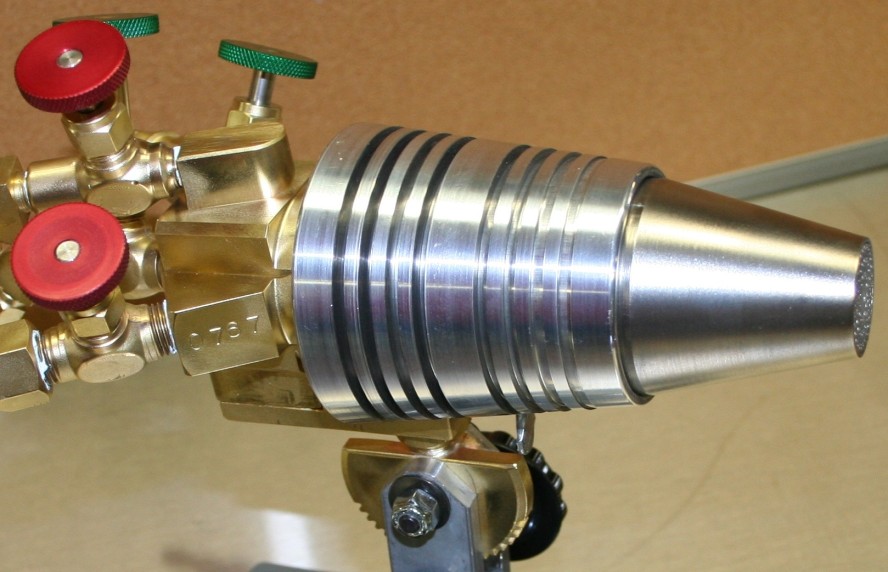
Carlisle CC+ Glass Torch
Hybrid (surface and premix)
$2,796*
US reference price
* Estimate: our reference US figure, not a list price from the maker.
Bench configuration shown.
Overview
Best for: Production, Goblets, General
- Mount
- Bench
- Fuel
- Propane, Natural gas
- Oxygen (estimate)
- ~30 LPM
Specs
The Carlisle CC+ is a larger, two-stage version of the classic CC, a premix center fire plus a surface-mix outer, with an added row of outer tubes for a bigger flame, a choice of centerfire tips, and four color-coded metering valves.
Intermediate-to-advanced makers doing production, goblet, and general soft-glass and boro work who want the CC's combination flame with more heat and a configurable center fire.
- Jets
- Not confirmed
- Stages
- 2
- Mount
- Bench
- Mix
- Hybrid (surface and premix)
Specs
- Mix type
- Hybrid (premix centre fire in a surface-mix outer)
- Mount
- Bench
- Oxygen (estimate)
- ~30 LPM
Documented estimate · editor's estimate, not a maker figure · checked 2026-07-18Oxygen use at the largest usable flame, not a minimum.
- Fuel
- Propane, Natural gas
- Skill level
- Intermediate, Advanced
- Glass
- Soft, Boro
- Best for
- Production, Goblets, General
- Price
- ~$2,796*Estimate
* Our reference US figure, not a list price from Carlisle. Confirm the current price with Carlisle.
- Stages
- 2
Figures come from Carlisle's own pages and manuals where we have them; the oxygen figure is a rough estimate, not a specification. Confirm the current spec with Carlisle before you buy.
How we source these figures
Treat the oxygen figure as a rough sizing estimate. Depending on the model it may be manufacturer full-flame consumption, a converted flow figure, or a documented estimate, and delivered pressure and purity matter as much as flow. What actually drives a torch choice is the glass, the work, and the flame, so size your oxygen supply after you pick the torch.
Prices may be manufacturer list prices or observed dealer references. Where a cell carries an evidence line it says where the figure came from, the date we checked it, and links the source where we hold one; a cell without one rests on the sources at the foot of the page. On a phone those lines show while this note is open. Confirm the exact configuration with Carlisle before buying.
Spec provenance: 1 of 7 spec fields on this page is a documented estimate of ours.
Overview
The Carlisle CC+ is the larger sibling of the classic CC, built for makers who want the same combination flame with more heat and more control. Like the CC, it pairs a premixed center fire (a flame like a Carlisle hand torch) with a surface-mixed outer fire, but it adds a row of tubes on the outer fire for a bigger flame, three interchangeable centerfire tips, and four color-coded metering valves.
The combination flame
The CC+ keeps the idea that made the CC a workhorse: a hot, detailed premix center for articulating stems and details, surrounded by a bushy, soaking surface-mix outer for keeping a larger area evenly warm. The extra outer row gives it more reach than the CC. To understand the two halves of the flame, see surface mix vs premix torches and soaking vs penetrating flame.
A configurable center fire
What sets the CC+ apart is how much you can tune it. Carlisle offers three centerfire tip types, a #3, a #5, and an unpiloted hydrogen tip for the hydrogen configuration, so you can match the premix center to your fuel and the work, and four color-coded metering valves give you independent control over the fires. That flexibility is the appeal for a working maker, but it’s also more to learn than a single-valve torch.
Who it’s for
The CC+ suits intermediate-to-advanced makers doing production, goblet, and general soft-glass and boro work who want the CC’s combination character with more heat. As with any combination Carlisle, the premix center rewards a careful, consistent startup and shutdown routine, so it isn’t a first torch, beginners are better served by the gentler Mini CC; if you’re mapping the range, see how to choose a glass torch.
Glass, fuel & oxygen
The CC+ handles soft (soda-lime) glass and boro, and burns propane or natural gas; Carlisle’s CC-family instruction sheet runs hydrogen only on the dedicated CC-H configuration, which uses a non-piloted hydrogen centerfire tip. Carlisle doesn’t publish the CC+‘s jet count or exact oxygen flow in our source data, so we won’t put numbers on it, confirm those with Carlisle and match them to your oxygen supply before buying. For sizing your system, see how many LPM does my torch need.
Where it sits in the Carlisle lineup
The CC+ sits a step above the CC and below the largest CC++, which adds yet another outer row for still more heat. Below them sit the combination CC and the beginner surface-mix Mini CC. It’s the natural pick when the CC’s flame is right but you need more of it.
Before you buy
Budget for the whole system, not just the torch: oxygen (a concentrator or tanks), the correct propane or natural-gas regulator (hydrogen only on a CC-H configuration), flashback protection matched to your torch and gas supply, didymium or boro-rated eyewear matched to your glass, and ventilation. New to plumbing a torch? Start with the fittings, hoses & connectors guide and the glass torch safety setup guide.
Editor’s note: spec details reflect Carlisle’s own materials. Carlisle doesn’t publish the CC+‘s exact jet count or oxygen flow in our source data, so confirm those specifics, and current pricing, with Carlisle before purchasing.
Fit and tradeoffs
Best for: Intermediate-to-advanced makers doing production, goblet, and general soft-glass and boro work who want the CC's combination flame with more heat and a configurable center fire.
Not for: Beginners and anyone wanting the simplest, calmest possible flame, the combination design rewards a careful startup/shutdown routine and a confident hand on four valves.
Pros
- + Combination flame: premix center fire plus a bushy surface-mix outer
- + Bigger flame than the CC thanks to an added row of outer tubes
- + A choice of centerfire tips (#3 or #5, plus a hydrogen tip on the hydrogen configuration) for a configurable center
- + Four color-coded metering valves for fine control
- + Burns propane or natural gas; hydrogen needs the dedicated CC-H configuration
Cons
- − Combination design rewards a careful, consistent startup/shutdown routine
- − Four valves and a configurable center mean more to learn than a simple torch
- − High price band; an intermediate-to-advanced purchase
- − Jets and oxygen flow aren't published; confirm those and current pricing with Carlisle
Reader reviews
No reader reviews yet. If you have worked on this torch, yours would be the first, and it is read by the editor before it appears.
Write a review of the Carlisle CC+
Flame notes
Larger version of the CC with an added row of tubes on the outer fire for a bigger flame. Combination torch: premixed centerfire (flame like a Carlisle hand torch) plus a surface-mixed outer fire. Carlisle offers three centerfire tip types (#3, #5, and an unpiloted hydrogen tip); per the CC-family instruction sheet, hydrogen is run only in the dedicated CC-H configuration, and hydrogen is not recommended with the piloted #5 or #3 tips. Four color-coded metering valves. Manual (shared CC-family sheet): same recommended pressures as the CC; max capacity 360 CFH oxygen on NG, double the CC. The RP model is a CC+ variant spec by Roger Parramore: stainless nose cone, 45 degree inlets, rack and pinion mount.
Manuals & instructions
Manufacturer documentation on the maker's own site, which holds the current revision.
Maker
Carlisle Machine Works
USA · Founded 1918
Focus: Soft, Boro, Beads
Family-owned Millville, New Jersey manufacturer. Its current glassworking line includes combination, surface-mix, bench, and hand torches. Carlisle says the CC was developed with Corning in 1939.
Related reading
Compared with
Head-to-head guides that put the CC+ against other torches.
FAQ
- How is the CC+ different from the CC?
- The CC+ is a larger version of the CC with an added row of tubes on the outer fire for a bigger flame. It keeps the combination design, a premixed centerfire (with a flame like a Carlisle hand torch) plus a surface-mixed outer, and adds a configurable center (a choice of centerfire tips) and four color-coded metering valves.
- What are the three centerfire tips?
- Carlisle's CC-family materials describe three centerfire tip types: the piloted #5 and #3 for propane and natural gas, and an unpiloted hydrogen tip for the hydrogen configuration. Choosing the tip lets you tune the premix center fire to your fuel and the work in front of you.
- What fuels does the CC+ run?
- Propane or natural gas. Carlisle's CC-family instruction sheet runs hydrogen only on the dedicated CC-H configuration, which uses a non-piloted hydrogen centerfire tip; Carlisle does not recommend hydrogen with the piloted #5 or #3 tips, because it can burn the tip out quickly.
- Is the CC+ good for beginners?
- It's pitched at intermediate-to-advanced makers. The combination design and four-valve control ask more of the operator than a simple surface-mix torch. Beginners are better served by Carlisle's Mini CC.
- How much oxygen does the CC+ need?
- Carlisle doesn't publish exact oxygen flow for the CC+ in our source data, so we won't invent a figure. Confirm it with Carlisle and match it to your oxygen supply before buying.
Researched and edited by Joe Blanchard, sixteen years on the distribution side of the glass industry.