Bethlehem Bravo: the quiet 18-jet two-stage surface-mix bench torch
Bethlehem Bravo · Bench torch · Surface mix
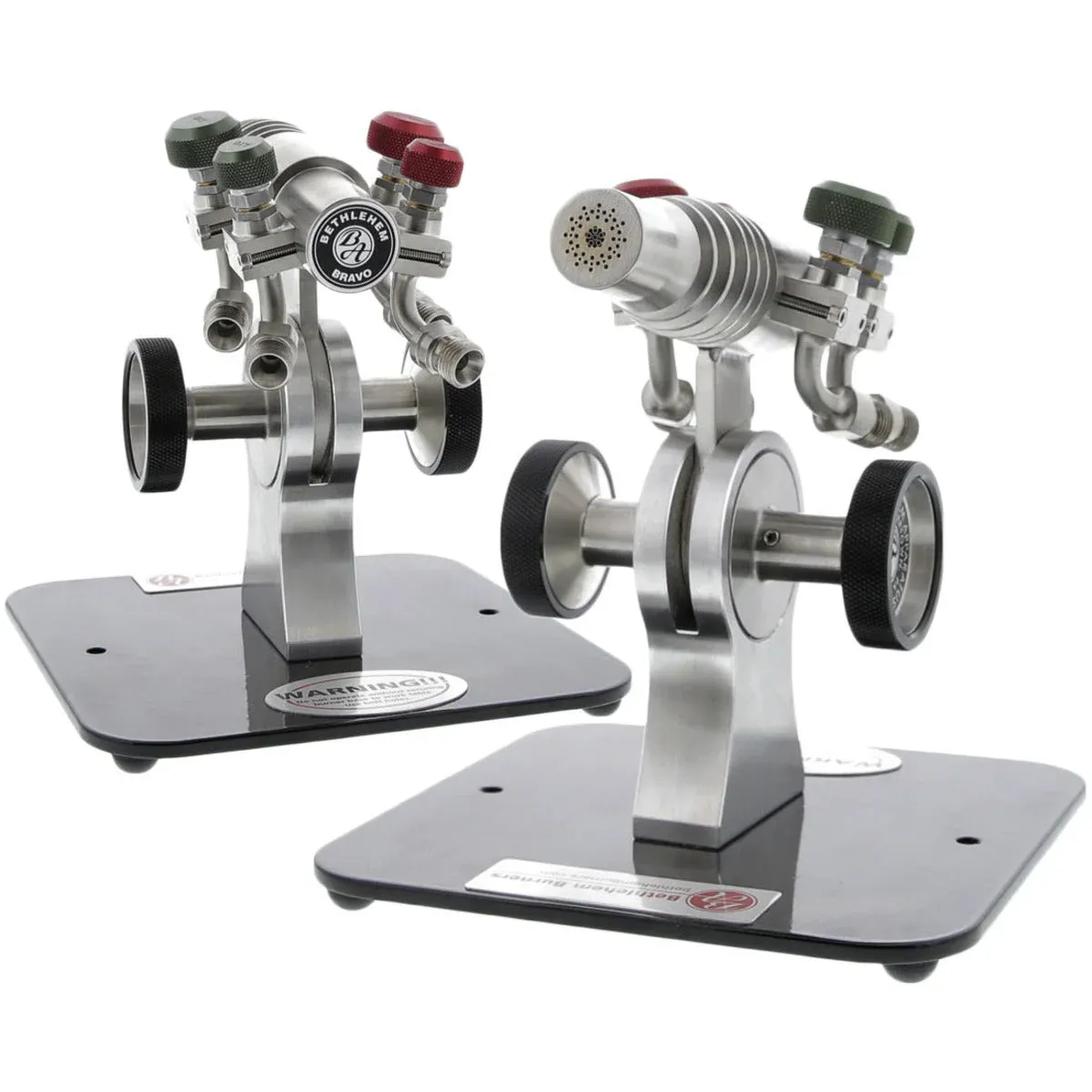
The Bethlehem Bravo is a compact, whisper-soft, two-stage surface-mix bench burner, a 6-jet centerfire inside a 12-jet outer fire, that replaced the Barracuda and runs efficiently enough for household gas and oxygen concentrators.
Specs
- Mix type
- Surface mix
- Mount
- Bench
- Oxygen (estimate)
- ~30 LPM
- Fuel
- Propane, Natural gas, Hydrogen, Butane
- Skill level
- Beginner, Intermediate
- Glass
- Soft, Boro
- Best for
- Small-to-medium work, Soft glass, Boro
- Price
- ~$1,171 (reference)
- Jets
- 18
- Stages
- 2
Manufacturer manual
Manufacturer manual
Manufacturer page
Manufacturer manual
Manufacturer page
Manufacturer page
Manufacturer page
Manufacturer manual
Treat the oxygen figure as a rough sizing estimate, not a specification. Depending on the model it may be manufacturer full-flame consumption, a converted flow figure, or a documented estimate, and delivered pressure and purity matter as much as flow. What actually drives a torch choice is the glass, the work, and the flame, so size your oxygen supply after you pick the torch. Prices may be manufacturer list prices or observed dealer references. Use the evidence label and sources below, then confirm the exact configuration before buying.
Overview
The Bethlehem Bravo is a compact, two-stage surface-mix bench burner and one of the easiest Bethlehem torches to recommend. It runs a 6-jet centerfire inside a 12-jet outer fire, 18 jets on a 1in face, and is known for a whisper-soft, oxygen-efficient flame on both stages. It replaced the older Barracuda in Bethlehem’s line and carries the brand’s stainless-steel body and swivel base.
What the surface-mix flame gives you
Like all of Bethlehem’s burners, the Bravo is surface-mix: fuel and oxygen meet at the face rather than premixing inside the torch. Running surface mix on both the inner and outer flames gives the Bravo a notably quiet, calm, low-backfire character that’s gentle on colors, a big reason Bethlehem is trusted in scientific and production settings. For why that matters, see surface mix vs premix torches; if you share a studio, the Bravo also earns a place in our quietest torches for shared studios roundup.
Two stages, independently controlled
The Bravo’s two fires are controlled separately, so you can run a small, focused centerfire flame for detail or open the outer fire for a broader soaking flame. That range, from a fine flame up to the full two-stage flame on the 1in face, is what lets one torch cover both delicate work and medium melt-ins.
Glass, fuel, and oxygen
The Bravo handles soft (soda-lime) glass and boro and is unusually flexible on supply. The catalog gives a concrete picture: full flame is roughly 6 LPM gas and 30 LPM oxygen, at about 2 to 5 psi gas and 8 to 20 psi oxygen, but it also runs on household gas (around 1/4 psi) and on oxygen concentrators (around 7 psi). The takeaway: the Bravo will sip on a modest setup for small flames, but the full flame’s ~30 LPM oxygen is more than a single small concentrator delivers, size your oxygen to the flame you actually want. See how many LPM does my torch need and oxygen concentrator vs tanks.
The hardware advantage
A stainless-steel construction keeps the body cool, and the Bravo carries Bethlehem’s swivel base and scroll pedestal, letting you set the torch to a precise, repeatable angle and height. That repeatability is a genuine ergonomic advantage over long sessions and part of what you’re paying for.
Where it sits in the Bethlehem lineup
The Bravo is the balanced middle of the surface-mix range: above the entry Alpha, Star, and gap-filling STACKS, and below the stronger two-stage Champion and the multi-stage Grand. There’s also a Bravo Sharp Flame variant that swaps in Bethlehem’s Sharp Flame centerfire. Because the flame behavior is consistent across the family, stepping up doesn’t mean relearning your torch, compare the tiers in Alpha vs Bravo vs Champion.
Before you buy
Budget for the whole system, not just the torch: oxygen (a concentrator or tanks), the correct propane or natural-gas regulator, flashback protection matched to your torch and gas supply, didymium or boro-rated eyewear matched to your glass, and ventilation. New to plumbing a torch? Start with the fittings, hoses & connectors guide and the glass torch safety setup guide.
Editor’s note: spec details reflect Bethlehem’s own catalog and product page (compiled 2026-07-18, not independently re-verified). Confirm the current price and your exact oxygen needs for the flame size you want with Bethlehem before purchasing.
Fit and tradeoffs
Best for: Beginners through intermediates doing small-to-medium soft glass and boro who want a quiet, oxygen-efficient flame and Bethlehem's precise mounting hardware.
Not for: Large boro tubes, thick solid work, or high-volume production heat, step up to the Champion or a multi-stage Grand for that.
Pros
- + Whisper-soft, oxygen-efficient surface-mix flame on both inner and outer fires
- + Two independently controlled stages: 6-jet centerfire + 12-jet outer fire (18 jets) on a 1in face
- + Flexible fuel/oxygen range, runs on household gas and oxygen concentrators as well as tanks
- + signature swivel and swivel base
- + Handles both soft glass and boro
Cons
- − Not built for large boro or production-scale heat
- − Full-flame oxygen demand (~30 LPM) is more than a single small concentrator delivers
- − Premium mounting hardware is part of the price
Flame notes
Two-stage surface-mix bench burner that replaced the Barracuda. It has a 6-jet center fire and 12-jet outer fire on a 1-inch face. Bethlehem lists 6 LPM gas and 30 LPM tanked oxygen at full flame. It comes with a swivel base and scroll pedestal.
Maker
Bethlehem Burners
USA · Founded 1950
Focus: Scientific, Production, Boro
A division of Bethlehem Apparatus Company. Bethlehem says it has manufactured surface-mix glassworking torches since 1950.
Related reading
Compared with
Head-to-head guides that put the Bravo against other torches.
- Bethlehem Alpha vs Bravo vs Champion: Which Bench Torch?
- Bethlehem Bravo vs GTT Phantom: Which Production Bench Burner?
- Bethlehem Bravo vs Nortel Red Max: Cross-Brand Bench Torch Comparison
- GTT Cheetah vs Bethlehem Bravo: Mid-Range Boro Torch Compared
- GTT Lynx vs Bethlehem Bravo: Which Mid-Tier Boro Torch Wins?
- Herbert Arnold Big Arni vs Bethlehem Bravo: Two Surface-Mix Bench Torches Compared
FAQ
- What's the difference between the Bravo and the Champion?
- Both are two-stage surface-mix Bethlehem bench torches. The Bravo is the compact, whisper-soft burner for small-to-medium soft glass and boro; the Champion steps up to a stronger flame for intermediate-to-advanced medium work and larger-diameter boro. See our Alpha vs Bravo vs Champion guide for the full comparison.
- Did the Bravo replace the Barracuda?
- Yes. Per the catalog, the Bravo replaced Bethlehem's older Barracuda bench burner.
- Can the Bravo run on an oxygen concentrator?
- It can run on oxygen concentrators and even household gas, which is part of its appeal. Note, though, that the catalog lists roughly 30 LPM of oxygen at full flame, more than a single small concentrator delivers, so size your oxygen to the flame you actually want. See how many LPM does my torch need.
- Is the Bravo quiet enough for a shared studio?
- It's described as whisper-soft, which is characteristic of Bethlehem's surface-mix flame. That makes it a strong pick for shared spaces; see our guide to the quietest torches for shared studios.
- Soft glass, boro, or both?
- Both. The Bravo works soft (soda-lime) glass and boro comfortably; it's built for small-to-medium work rather than large tubes or thick solid pieces.