Short answer: The familiar connection between Moretti and Effetre comes from a family glassmaking tradition and a later factory acquisition. Effetre existed before it took over the Ulderico Moretti glassworks. Its own history still connects its glass to Vincenzo Moretti’s work, which helps explain why lampworkers encounter both names. The distinction matters: a family, a factory, a company and a label on a bundle of rods can have different timelines. [6, 7]
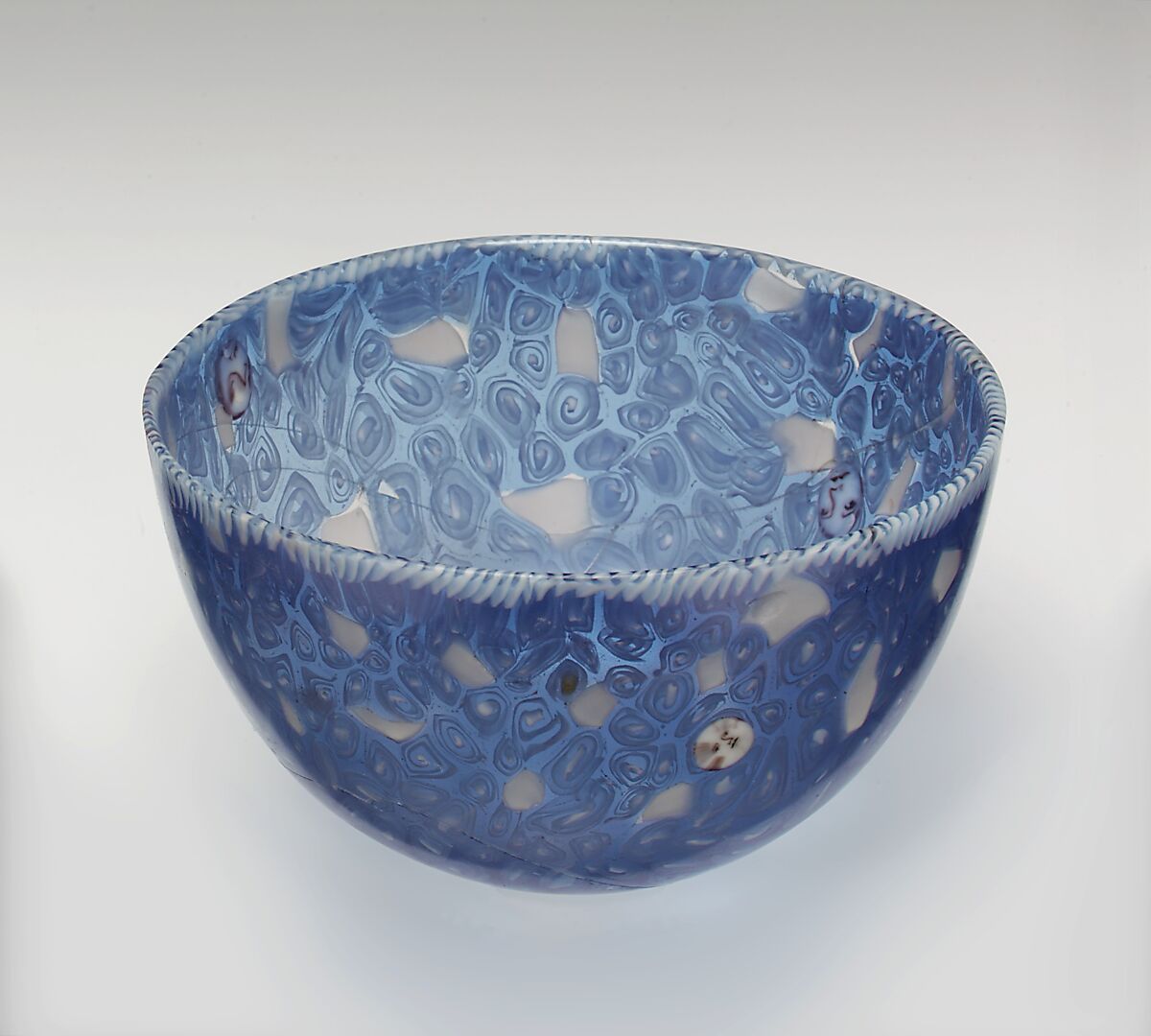
Look closely at the blue surface of the bowl above. Rings and curls occupy separate patches. Small faces appear between them. The rim carries another repeated pattern. The decoration belongs to the structure of the object: this is a bowl assembled from patterned glass, with an image appearing wherever a patterned element meets the surface.
The Met’s attribution places Vincenzo Moretti and the Venezia-Murano Company together. Its date puts the bowl decades before the family firm most relevant to the later rod business. That is the first useful separation in this history: Moretti’s achievement as a glassmaker began before the companies that would carry the name forward. [1]
Murano before the bundle of rods
The nineteenth-century Moretti story belongs to a wider revival on Murano. The island’s makers were recovering difficult techniques, studying earlier objects and finding buyers for new work made in older traditions. Museo del Vetro describes a recovery involving glassmakers, entrepreneurs and the museum itself, whose teaching and collections supported the furnaces. Its account places Vincenzo Moretti’s work on murrine alongside Lorenzo Radi’s research into chalcedony glass. [2]
The museum also identifies different commercial approaches. F.lli Toso specialized in antique models; Salviati’s work reached foreign markets, especially Britain, and international exhibitions. Moretti worked within this world of technically ambitious glass and buyers interested in its historical associations. [2, 3]
It would be misleading to begin this story with the modern phrase “104 glass” and project that specification back onto every object. A museum attribution establishes who made an object and roughly when. It does not establish the expansion characteristics of every colored component, or prove that a present-day rod is chemically identical to nineteenth-century glass.
Vincenzo Moretti: the material behind the image
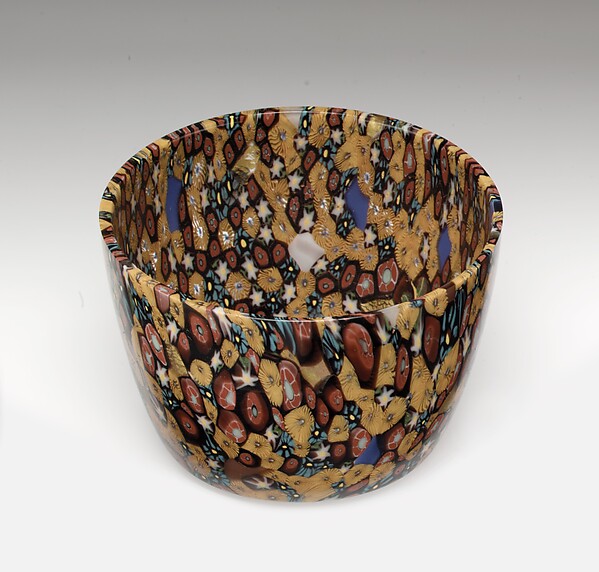
Vincenzo Moretti lived from 1835 to 1901. Nicola Moretti’s family history describes an early career pulling cane at Pietro Bigaglia’s bead factory, followed by work for Antonio Salviati’s Compagnia Venezia Murano. It emphasizes his technical role in glass composition and the recovery of older glassmaking methods. This was knowledge of the material as well as skill in shaping it. [3, 4]
Giusy Moretti records recognition for Vincenzo at exhibitions in Murano in 1869 and Paris in 1878. The Met describes Abbot Vincenzo Zanetti’s museum and archive as part of the recovery of earlier techniques. [1, 4]
Murrina, murrine and millefiori
The vocabulary becomes less confusing when attached to the process. A murrina is a patterned glass element; murrine is the plural. Millefiori, literally “a thousand flowers,” describes the familiar flowerlike patterned glass associated with many such canes. The terms overlap in workshop and commercial usage, but not every murrina depicts a flower.
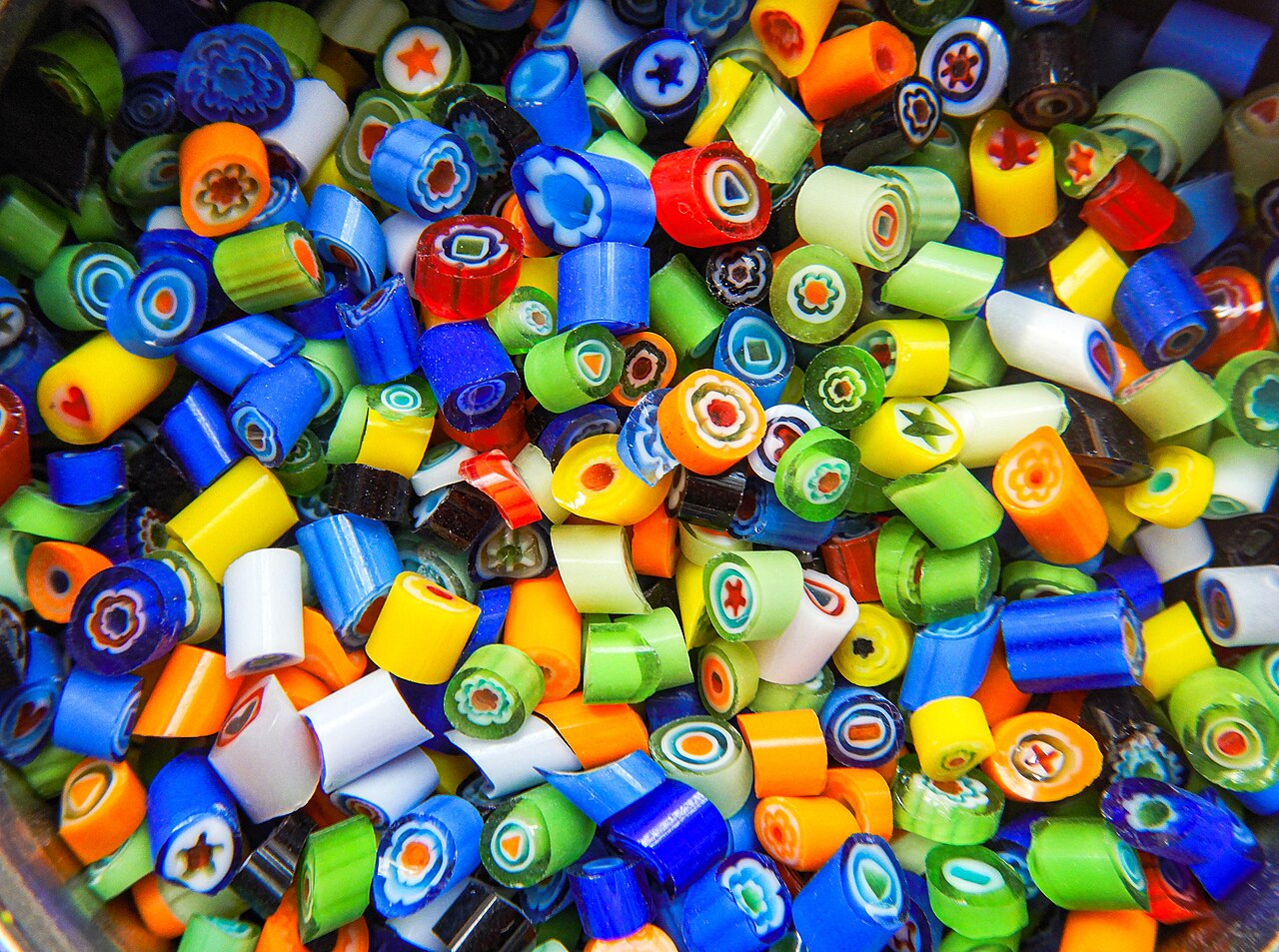
Museo del Vetro describes millefiori canes built from layers of colored glass, with molds helping create the star-shaped structure. The hot cane is drawn down, cooled and cut into sections. Those sections can be assembled and fused, or incorporated into another glass object. Its account places nineteenth-century work in a much longer history that includes Roman mosaic glass and earlier Venetian production. [5] The same build, pull and slice sequence at torch scale is covered in our murrine and millefiori lampwork guide.
A useful way to read the finished pattern is from the center outward. Each boundary between colors records part of the original construction. Pulling the cane reduces those boundaries together. Cutting reveals them. Heating the resulting slices into a vessel adds another challenge: enough movement to join the pieces, while retaining the design the maker wants to show.
This is also why the Moretti story should not be told as the invention of murrine. The museum identifies contributions by Giovanni Battista Franchini and his son Giacomo, including intricate cane and miniature portraits. Moretti was a major participant in a revival with multiple contributors and much older precedents. [5]
Luigi, Ulderico and a family business
With Luigi Moretti, the family narrative moves further into the extraordinary possibilities of pictures inside cane. Giusy Moretti’s account lists portraits of rulers, political figures and religious subjects, alongside flowers, birds and geometric designs. A portrait pushes the process beyond a repeating star: small relationships between features have to remain legible after the glass is reduced. [4]
The same family account dates the establishment of Moretti Luigi & Bros to 1900, with Vincenzo and Luigi’s brothers Vittorio and Cesare involved. Nicola Moretti’s account then traces the work through Luigi’s sons Ulderico, Germano, Mario and Pietro, describing continued production of colored rods and millefiori. These are family histories, and the attribution is worth keeping visible. [3, 4]
Giusy connects Ulderico’s rooster murrine with Murano’s incorporation into Venice in 1923 and records their use in his home’s floor. The island’s symbol carried a connection to place as well as demonstrating technique. [4]
Editor’s note: Nicola’s family account gives Luigi’s birth year as 1865; Giusy’s gives 1867. The year remains unresolved here. [3, 4]
How Moretti became associated with Effetre
The clearest concise chronology comes from the Bayerisches Nationalmuseum’s Murano exhibition catalog. Its Effetre entry records three separate events. [6]
| Date | Recorded event | What it establishes |
|---|---|---|
| 1976 | Guido, Mario and Ivano Ferro founded Vetreria Effetre International. | Effetre had its own history before the Moretti takeover. |
| 1995 | Effetre took over the glassworks of Ulderico Moretti & C. | The connection includes an acquisition of a named glassworks. |
| From 2010 | The entry uses Effetre Murano S.r.l. | The catalog distinguishes a later company name. |
The catalog also records Lino Tagliapietra as Effetre’s artistic director from 1976 to 1989 and includes his 1984 Rainbow vase made by Vetreria Effetre International. That object is useful evidence of the company’s earlier activity. Effetre did not first appear when it acquired the Moretti glassworks. [6]
So “Moretti changed its name to Effetre” works only as loose workshop shorthand. It compresses a pre-existing company, a factory acquisition and a later name into one event. It can help someone recognize a familiar glass label, but it leaves out most of the business history.
The more accurate explanation is that the Moretti glassworks became part of Effetre’s history. Today’s manufacturer explicitly connects its products with Vincenzo Moretti’s nineteenth-century work and says that connection explains the continued use of the Moretti name. This is the present maker’s own account of its inherited identity. [7]
What a takeover does, and does not, tell us
A factory acquisition gives a historical connection much firmer than a shared surname. It identifies an operation and a change in control. It does not, on its own, document every recipe, employee, furnace or production method that continued afterward.
For a glassworker, that distinction becomes practical when someone asks whether old Moretti stock is “the same” as a new Effetre rod. The question might mean the same business lineage, the same color number, the same working behavior or the same measured properties. Those are different questions, requiring different evidence.
The museum chronology answers the lineage question. It cannot certify a particular unlabeled rod: a surviving catalog, package label or documented sample can identify that rod, and comparison testing can address a proposed use. Nor does it give a date when buyers stopped saying Moretti; establishing when labels or catalogs changed would take dated examples of those materials, and trade usage need not change on the day ownership does.
A family surname is not a company directory
Moretti also remains a living family name in glassmaking. Nicola Moretti’s history records the establishment of Nicola Moretti Murano by Alberto and Nicola in 2013. That is a distinct business story, not a later name for Effetre. [3]
The same care is needed when encountering Ercole Moretti or Carlo Moretti. A shared surname on a beautiful object, a film or a factory photograph does not make it evidence for the particular Moretti-to-Effetre succession discussed here. The maker’s full name and the object’s attribution matter.
From the furnace to the lampworker’s bench
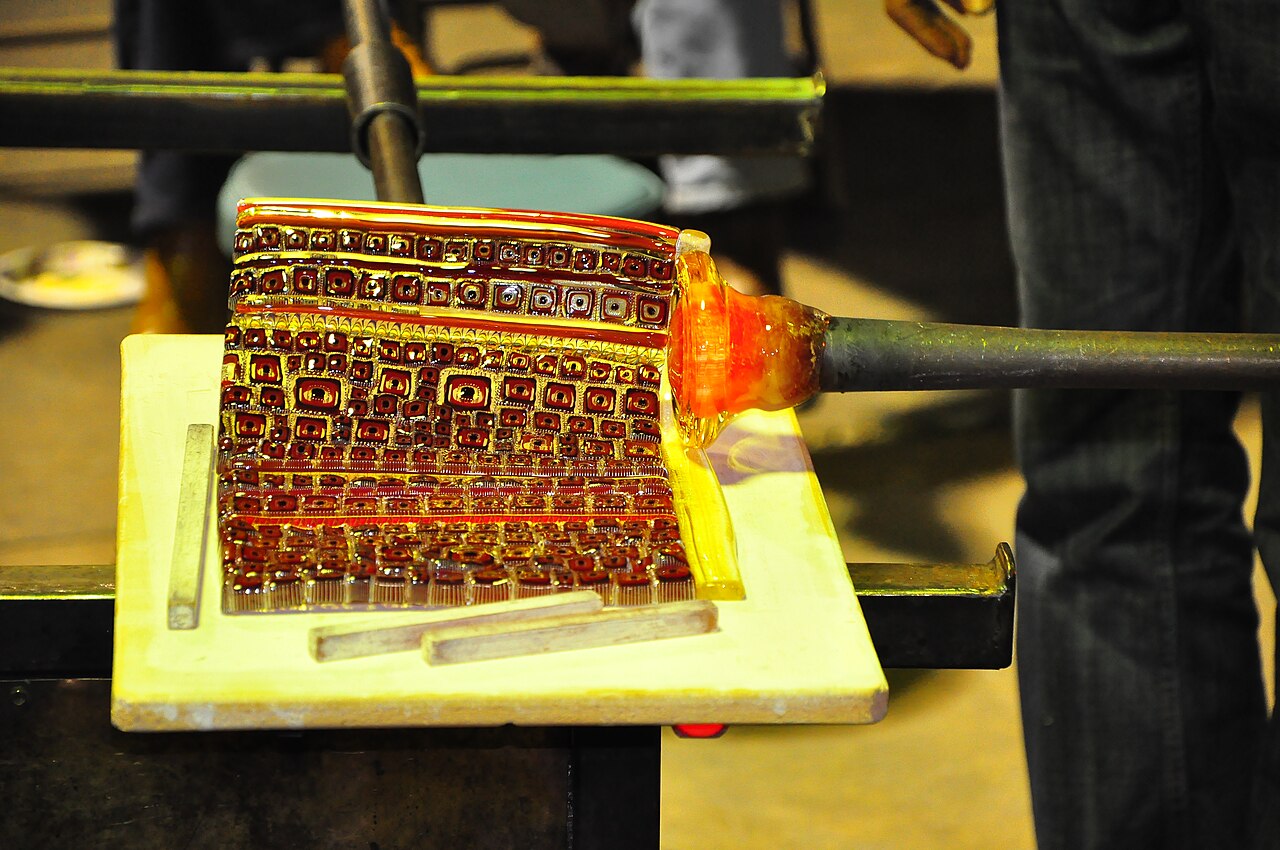
Effetre’s present range shows the breadth of a business supplying glass for further work. Its official history page lists rods, millefiori, filigree, sheets, frits, blocks and tubes, alongside other cane products. It describes a combination of traditional glassmaking and modern production technology. [7]
Handmade and machine-made belong in the same story
Effetre’s rod page distinguishes traditional color families from newer machine-made and handmade collections. Its traditional categories include Transparent, Pastel, Alabaster, Special and Opaline. The page describes roughly 200 shades and rods supplied in lengths of about a meter, grouped by color and size. These are the manufacturer’s published descriptions, not an inventory guarantee for every color. [8]
So the modern range is not unchanged hand-pulled cane, and neither label settles a working question: “handmade” or “machine-made” says how a rod was produced, not its compatibility, diameter tolerance or color behavior. For that, the useful unit is the identified product and what its maker says about it.


What “104” adds to the name
Effetre publishes a coefficient of thermal expansion of (104 ± 1.5) × 10⁻⁷ per degree Celsius over 0 to 300°C for its rod glass. The temperature interval is part of that statement. The familiar “104” is a convenient shortened designation, not the whole technical description. [8]
Two consequences follow. First, the number is about the material’s change with temperature, not the age of the company or the method used to pull a rod. Second, sharing a nominal expansion category is not enough to prove that every combination of colors and constructions will work. Compatibility also concerns how the glasses behave together through heating and cooling. [14] Our compatibility deep dive explains why.
For the differences between broad material families, see soft glass, borosilicate and quartz. For a specific project, use the current glassmaker’s guidance and an annealing approach appropriate to the work. A historical article should not turn a material label into a universal kiln program.
Further viewing: Effetre in a named collaboration
YALI’s official page for Film 5: Making the YALI Tondo credits designer Marie-Rose Kahane, Ivano Ferro of Effetre and the Toffolo Brothers. It provides a specifically attributed contemporary connection to Effetre, rather than generic footage found under “Murano glass.” [9]
Vetrofond: another name in the Italian palette
Vetrofond belongs in the soft-glass story, but its rod history should not be filled in from assumptions about Effetre. Creation Is Messy’s compatibility documentation identifies Vetrofond clear as one of the actual glasses against which it tests. That provides direct manufacturer evidence of Vetrofond’s place in the working palette. [14]
There is also a documented lighting-glass business connection. Vistosi’s own history records Giancarlo Moretti’s takeover of Vistosi in 1989 and identifies his earlier business interests in Vetrofond and Punto Luce. It is evidence of a business relationship in that industry. It does not establish that he belonged to the particular family succession described above. [10]
For an artist holding Vetrofond, the useful record begins with the material itself: retain the original label, color identification and any reliable batch information. Keep a sample with project notes when the glass has a distinctive behavior. A memorable result can remain useful even when the broader manufacturing chronology is incomplete.
Editor’s note: This research did not establish a primary-source end date for Vetrofond rod production or a complete legal chain linking historical rods with every present use of the company name. No closure date or uninterrupted-production claim is asserted here.
Double Helix: developing glass for reactions
Double Helix illustrates a different way to extend a soft-glass palette. Its official history dates the business to 2006, founded by Jed Hannay, with Julie Hannay handling the business side. Jed had begun flameworking in 1999. The company describes its production in Charlottesville, Virginia, using electric furnaces and machine-pulled rods. [11]
Its range includes reactive silver glass, premium clear, gold-bearing glass and the Oracle line. The maker describes formulation, production and testing as closely connected, with batch tracking and checks for compatibility, consistency and quality. That gives the reader a better picture of the business than treating its rods as additional Italian color numbers. [11]
A reactive glass adds another variable to the artist’s work: the heating sequence and flame conditions can become part of developing the appearance. That is why a photograph of a finished bead does not function like a simple color swatch. It records the result of a process as well as the material chosen.
The company’s official video tutorials include a Basic User’s Guide, Practicing Reduction with Triton, Practicing Striking with Terranova and Making Murrini. Those titles indicate where to look for product-specific instruction; one product’s demonstration should not become a universal procedure for the entire range. [12]
For practical background, read striking and silver-glass basics, followed by the guidance for the exact glass being used. Our Effetre and Double Helix compatibility guide addresses the bench questions separately from this history.
Creation Is Messy: building the colors artists asked for
Creation Is Messy, usually shortened to CiM, describes a business built around a partnership with a small family factory near Yancheng, China, and a chemist named Zhou. Its company story dates its hand-pulled glass production to 2006 and emphasizes requests from working artists. [13]
The initial colors it names are revealing: Gelly’s Sty, a pink; Celadon, an opaque seafoam; and Butter Pecan, a rich beige. These were specific additions to an existing palette. The story later includes colors and effects such as dense opaque Peace, Moonstones such as Cirrus, and different kinds of opal glass. [13]
CiM’s most useful technical contribution to this discussion is the way its compatibility page frames testing. It describes comparisons against actual base glasses, including Effetre, Vetrofond and Lauscha clear, using tests that examine strain. It also identifies factors beyond nominal expansion, including viscosity, working conditions, annealing and the geometry of a piece. [14]
That is a more informative claim than a blanket promise that everything labeled 104 can always be mixed. Factory testing provides evidence for the combinations and methods examined. The artist’s construction can introduce additional questions, particularly where layers, proportions or thick and thin sections differ.
Reading the names on the bench
| Name | Its role in this story | Useful distinction |
|---|---|---|
| Moretti / Effetre | Family glassmaking history connected to a later factory acquisition and present manufacturer. | A historical name is not a batch identification. |
| Vetrofond | An Italian glass name documented in another maker’s compatibility testing. | Rod history and lighting-business history need separate evidence. |
| Double Helix | A U.S. maker with reactive and other specialty glasses. | Identify the product and follow its particular working guidance. |
| Creation Is Messy | An artist-informed palette developed with a Chinese factory. | Compatibility claims concern tested material combinations and conditions. |
Moretti remains the central story because it connects the image inside the cane with the material inside the bundle. Vincenzo’s bowl asks the viewer to notice how the glass was built. Luigi’s portraits make that internal construction the subject. The later rod business puts prepared color into other makers’ hands. Effetre’s acquisition gives that inheritance a documented place in a continuing manufacturer.
For the parallel history of clear technical glass, read Pyrex, Duran and Simax: from laboratory glass to art.
Related guides
- Soft-glass brands explained: the shorter comparison of the working palette.
- Effetre and Double Helix compatibility: combining glasses in a project.
- COE 104 annealing schedule: planning the cooling process for the work.
- Striking and silver-glass basics: the process vocabulary behind reactive colors.
- Soft glass, borosilicate and quartz: the wider material families.
Sources
Primary manufacturer, family and museum sources accessed October 7, 2026 UTC. Family histories are attributed where used. Film credits and source links accompany the media. Museum and Creative Commons image credits appear below each photograph.
[1] The Metropolitan Museum of Art, Murrine bowl with faces, ca. 1880, object 81.8.207. Object attribution, historical context and public-domain image.
[2] Museo del Vetro, 1850 to 1895: the revival. The wider nineteenth-century technical and commercial setting.
[3] Nicola Moretti Murano, La famiglia. Family account of Vincenzo’s career, later generations and the separate business established in 2013.
[4] Giusy Moretti, The history. Family chronology, Luigi’s portrait work, the 1900 firm and Ulderico’s rooster murrine.
[5] Museo del Vetro, From mosaic glass to millefiori: murrine. Process history and the contributions of the Franchinis and Moretti.
[6] Bayerisches Nationalmuseum, Murano exhibition catalog, printed page 25, Effetre entry; printed page 13, Tagliapietra’s Rainbow vase. Founding, glassworks takeover, later company name and artistic direction.
[7] Effetre Murano, Company history. The maker’s Moretti connection, production range.
[8] Effetre Murano, Glass rods. Published product families, manufacture, dimensions, expansion specification.
[9] YALI, Film 5: Making the YALI Tondo. Official film page and named collaborators.
[10] Vistosi, History. The 1989 takeover and the stated Vetrofond/Punto Luce business connection.
[11] Double Helix Glassworks, About. Founding, people, location, manufacturing and testing as described by the maker.
[12] Double Helix Glassworks, Video tutorials. Official further-viewing links.
[13] Creation Is Messy, Our story. Factory partnership, production history and development of the palette.
[14] Creation Is Messy, Compatibility. Named comparison glasses, testing and the limits of a nominal expansion designation.
[15] The Metropolitan Museum of Art, Millefiori bowl, ca. 1880, object 81.8.212. Attribution, construction and public-domain photograph.
[16] Albarubescens, Murrine millefiori, 2023. Photograph licensed CC BY-SA 4.0.
[17] Davidpatchen, Example of picking up murrine onto a blowpipe while blowing glass, 2009. Photograph licensed CC BY-SA 3.0.