GTT Scorpion: the two-stage workhorse with a selectable center fire
GTT Scorpion · Bench torch · Surface mix
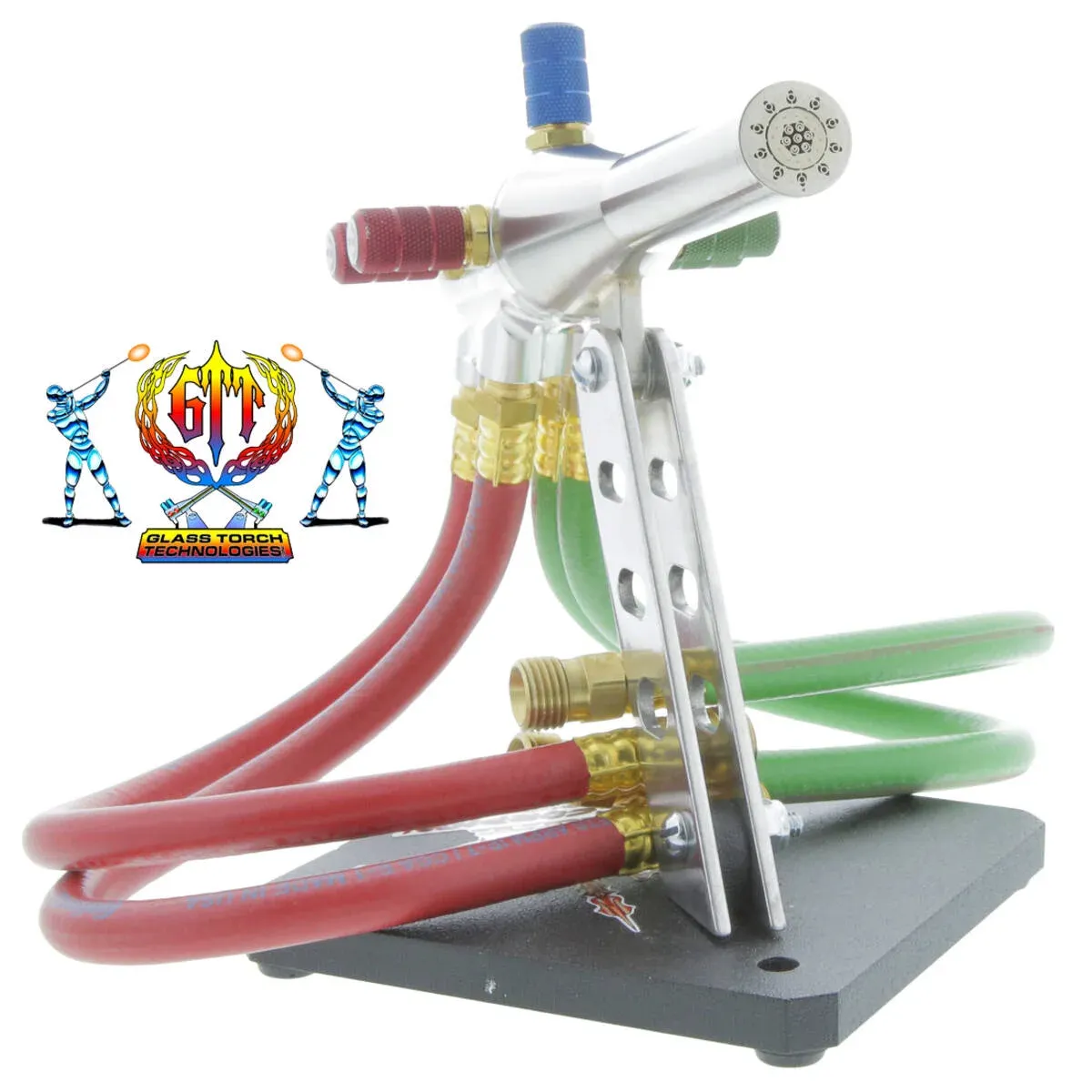
The GTT Scorpion is a two-stage surface-mix bench torch: the 5-jet Cricket center fire inside an 8-jet outer fire, 13 jets, working soft glass and boro in 2- and 4-stud versions. GTT lists one 10 LPM or two 5 LPM concentrators.
Specs
- Mix type
- Surface mix
- Mount
- Bench
- Oxygen (estimate)
- ~9.5 LPM
- Fuel
- Propane, Natural gas
- Skill level
- Intermediate, Advanced
- Glass
- Soft, Boro
- Best for
- Soft glass, Boro, Two-stage bench work
- Price
- ~$945 (reference)
- Jets
- 13
- Stages
- 2
Manufacturer page
Manufacturer page
Manufacturer page
Treat the oxygen figure as a rough sizing estimate, not a specification. Depending on the model it may be manufacturer full-flame consumption, a converted flow figure, or a documented estimate, and delivered pressure and purity matter as much as flow. What actually drives a torch choice is the glass, the work, and the flame, so size your oxygen supply after you pick the torch. Prices may be manufacturer list prices or observed dealer references. Use the evidence label and sources below, then confirm the exact configuration before buying.
Overview
The GTT Scorpion is Glass Torch Technologies’ two-stage workhorse: the 5-jet Cricket center fire inside an 8-jet outer fire, 13 jets in the standard version, offered in 2- and 4-stud configurations. GTT also sells a Lynx-center Scorpion as a separate product, which puts the patented Triple Mix pinpoint flame at the center and makes 15 jets. The outer fire uses GTT’s patent-pending surface-mix jet design, which GTT says makes the flame size of larger torches with fewer jets. It scales from a 2in pinpoint up to a 1.25in x 16in flame for solid boro to 3in, and GTT claims it melts through 3/4in solid boro rod in about a minute. On oxygen, GTT’s page lists one 10 LPM concentrator or two 5 LPM units, with two 8 LPM units or tanked oxygen as optimal; the page states 11 LPM (22 CFH) at maximum flame while GTT’s Flow Rate Chart lists 20 CFH (about 9.5 LPM), so size for the higher figure. Fuel runs from 1/4 to 5 psi of natural gas or propane at about 1.5 LPM (3 CFH) at the largest flame.
What the two-stage design gives you
Both stages are surface mix, fuel and oxygen meet at the torch face, keeping the flame clean, quiet, and kind to colors. The center fire handles detail; opening the outer fire adds a broad, penetrating band of heat for wide beads and heavy boro. Whether the center is the Triple Mix Lynx or the standard-mix Bobcat, the outer fire is the same. For the technology background see GTT Triple Mix technology and surface mix vs premix torches; for why a penetrating flame matters on heavy boro, read soaking vs penetrating flame.
Who the Scorpion is for
The Scorpion suits makers who have outgrown a single-stage torch and want one burner that covers detail through 3in solid boro, without the oxygen bill of a true production torch. GTT notes it works soft glass and borosilicate with ease, which makes it a genuine all-rounder rather than a boro-only specialist.
Glass, fuel, and oxygen
The Scorpion burns propane or natural gas with oxygen. Size your supply to the largest flame you actually use, not the smallest: start with how many LPM does my torch need.
Where it sits in the GTT lineup
The Scorpion is the bridge between GTT’s single-stage torches and the bigger multi-stage burners. Below it sit the Bobcat and Lynx (whose designs it borrows as center fires); above it, the Sidewinder adds a bigger outer fire, and the multi-stage Phantom and Mirage scale toward production work.
Before you buy
Budget for the whole system, not just the torch: oxygen supply, the correct propane or natural-gas regulator, flashback protection matched to your torch and gas supply, didymium or boro-rated eyewear matched to your glass, and ventilation. New to plumbing a torch? Start with the fittings, hoses & connectors guide and the glass torch safety setup guide.
Editor’s note: spec details reflect GTT’s published materials (jet counts, flame sizes, concentrator guidance). GTT sells the Scorpion in multiple configurations, confirm the center fire, stud count, and current pricing with GTT before purchasing.
Fit and tradeoffs
Best for: Makers who want two-stage flexibility, a fine center flame plus a broad outer fire for solid boro to 3in, without committing to a tank-fed production torch.
Not for: Furnace-scale production or the biggest boro, that's Mirage/Delta Mag territory. Also more torch than a first-time beadmaker needs.
Pros
- + Two-stage flexibility: a selectable center fire plus a dedicated outer fire
- + Standard version uses the Cricket center fire; GTT sells a Triple Mix Lynx-center version separately
- + GTT lists one 10 LPM or two 5 LPM concentrators, optimal on two 8 LPM or tanked oxygen
- + Flame from a 2in pinpoint up to 1.25in x 16in; solid boro to 3in
- + Works soft glass and borosilicate with ease
Cons
- − Mid price band; a step up from single-stage torches
- − More torch than detail-only or bead-focused work needs
- − Choice of center fire changes the flame character, pick deliberately
- − GTT's product page (11 LPM) and its Flow Rate Chart (about 9.5 LPM) give different oxygen figures at maximum flame
Flame notes
Two-stage standard surface-mix torch: the 5-jet Cricket as the center fire inside an 8-jet outer fire, 13 jets total; GTT also sells a Lynx-center version (7 + 8 = 15 jets) as a separate product, and the catalog price is GTT's listing for that Lynx-center version. Outer fire uses GTT's patent-pending surface-mix jet design. Flame from a 2in pinpoint up to 1.25in wide by 16in long; solid boro to 3in diameter; GTT claims it melts through 3/4in solid boro rod in about a minute. 2-stud or 4-stud versions (4-stud allows a foot pedal on the outer fire and split oxygen sources). Fuel 1/4 to 5 psi natural gas or propane, about 1.5 LPM (3 CFH) fuel at maximum flame per GTT's page; GTT's page states 11 LPM (22 CFH) oxygen at maximum flame while GTT's Flow Rate Chart lists 20 CFH (about 9.5 LPM), so GTT's own figures differ by 2 CFH.
Maker
Glass Torch Technologies
USA
Focus: Boro, Production, Pipe, Soft
Tioga, Pennsylvania maker of standard surface-mix, patented Triple Mix, and 4-Way Mix glassworking torches. GTT says it machines, builds, and tests its torches by hand.
Related reading
Compared with
Head-to-head guides that put the Scorpion against other torches.
FAQ
- What is the GTT Scorpion built for?
- Two-stage versatility: a center fire for detail plus an outer fire for wide beads and solid borosilicate up to 3in diameter. GTT notes it works both soft glass and boro with ease, in 2- and 4-stud configurations.
- How many jets does the Scorpion have?
- 13 in the standard version: GTT uses the 5-jet Cricket as the center fire inside an 8-jet outer fire built on its patent-pending surface-mix jet design. GTT also sells a Scorpion with the 7-jet Triple Mix Lynx center as a separate product, which makes 15. Confirm which center fire a current listing carries with GTT.
- Can the Scorpion run on an oxygen concentrator?
- Yes. GTT says the Scorpion was designed with concentrators, low pressure and low consumption in mind: it runs great on one 10 LPM concentrator or two 5 LPM units, and the optimal setup is two 8 LPM units or tanked oxygen. GTT's product page puts oxygen at 11 LPM (22 CFH) at maximum flame, while GTT's Flow Rate Chart lists 20 CFH (about 9.5 LPM); the two GTT figures differ by 2 CFH, so size your supply for the higher one.
- Cricket or Lynx center fire?
- The standard Scorpion's center is the 5-jet Cricket, GTT's most economical burner, which is what makes the whole torch efficient on a single 10 LPM concentrator. The Lynx-center version puts GTT's patented Triple Mix pinpoint flame at the center instead, 15 jets in total, and GTT sells it as its own product. Both share the same 8-jet outer fire.
- Soft glass or boro?
- Both. GTT positions the Scorpion as working soft glass and borosilicate with ease, the two-stage design covers detail work through 3in solid boro.