GTT Sidewinder: the two-stage surface-mix torch for assembly and spot heating
GTT Sidewinder · Bench or hand torch · Surface mix
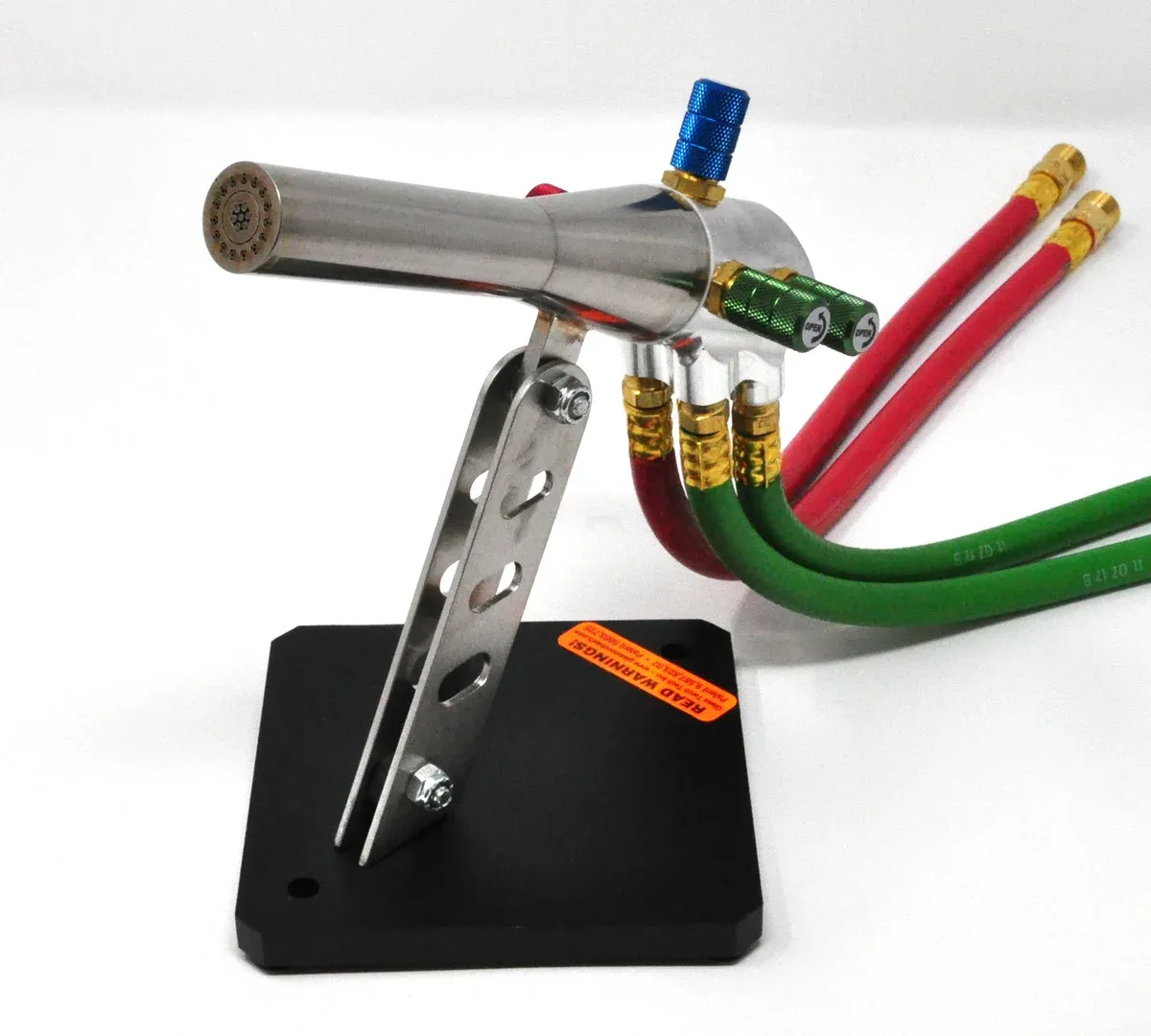
The GTT Sidewinder is a two-stage, 22-jet surface-mix torch, a 7-jet center fire (a standard-mix Bobcat or Triple Mix Lynx) plus a 15-jet, fully surface-mixed outer fire, offered as a hand torch with an on/off switch in the handle, and as a 2-/4-stud bench setup.
Specs
- Mix type
- Surface mix
- Mount
- Bench or hand
- Oxygen (estimate)
- ~15 LPM
- Fuel
- Propane, Natural gas
- Skill level
- Intermediate, Advanced
- Glass
- Soft, Boro
- Best for
- Wide beads, Paperweights, Marbles, Solid boro
- Price
- ~$1,125 (reference)
- Jets
- 22
- Stages
- 2
Manufacturer page
Manufacturer page
Manufacturer page
Manufacturer page
Treat the oxygen figure as a rough sizing estimate, not a specification. Depending on the model it may be manufacturer full-flame consumption, a converted flow figure, or a documented estimate, and delivered pressure and purity matter as much as flow. What actually drives a torch choice is the glass, the work, and the flame, so size your oxygen supply after you pick the torch. Prices may be manufacturer list prices or observed dealer references. Use the evidence label and sources below, then confirm the exact configuration before buying.
Overview
The GTT Sidewinder is Glass Torch Technologies’ versatile surface-mix torch, a two-stage, 22-jet burner with a 7-jet center fire (configured as a standard-mix Bobcat or a Triple Mix Lynx) and a 15-jet, fully surface-mixed outer fire. It’s built to bring a controllable surface-mix flame to assembly, spot heating, and off-bench boro work, and GTT offers it both as a hand torch with an on/off switch in the handle for the outer flame and as a 2-/4-stud bench setup. Few GTT torches are as flexible about how you mount and run them.
What the two-stage surface-mix flame gives you
The Sidewinder is a surface-mix design: fuel and oxygen meet at the face of the torch, keeping the mixing chamber cool and giving a clean, penetrating flame. Triple Mix, GTT’s patented mixing technology, enters only if you configure the center fire as a Lynx; the standard center is a Bobcat and the 15-jet outer is fully surface-mixed either way. The two stages let you go from a pinpoint up to a wide soaking flame, with the outer fire on its own switch in the hand-torch version. For the underlying tech see GTT Triple Mix technology and surface mix vs premix torches; for why a penetrating flame suits boro, read soaking vs penetrating flame.
Hand torch or bench
The Sidewinder’s calling card is flexibility. As a hand torch it’s ideal for assembly and spot heating, bringing the flame to a join or a localized area on a larger piece, with the outer flame on a thumb switch. As a 2-/4-stud bench torch it works as a fixed burner instead. If you’re deciding which format suits your work, see bench vs hand torch.
Who the Sidewinder is for
It suits intermediate-to-advanced makers who need a mobile, controllable flame for assembly, spot heating, and boro rather than a single fixed detail burner. The wide flame range, a tiny pinpoint up to 2.5in x 30in for solid boro to 3in, is what lets one torch cover both fine and large hand work.
Glass, fuel, and oxygen
The Sidewinder burns propane or natural gas with oxygen, and GTT says its flame suits soft glass and borosilicate alike. On the oxygen side, GTT says it runs great on two or three 8 LPM concentrators, and our catalog carries a ~15 LPM reference converted from GTT’s flow table for the largest usable flame; plan a multi-concentrator or tanked-oxygen supply and confirm with GTT. To size it to your work, see how many LPM does my torch need and oxygen concentrator vs tanks.
Where it sits in the GTT lineup
The Sidewinder is GTT’s mid-size hand torch / convertible, a surface-mix assembly torch sitting below the flagship Delta Elite hand torch. It shares its 7-jet center with the Lynx and Bobcat and its 15-jet outer ring with the Phantom, so the flame behavior is familiar across the line.
Before you buy
Budget for the whole system, not just the torch: a multi-concentrator or tanked oxygen supply, the correct propane or natural-gas regulator, flashback protection matched to your torch and gas supply, didymium or boro-rated eyewear matched to your glass, and ventilation. New to plumbing a torch? Start with the fittings, hoses & connectors guide and the glass torch safety setup guide.
Editor’s note: spec details reflect GTT’s own materials. The catalog price is GTT’s listed price for the 2-/4-stud bench configuration with Lynx center fire, and the oxygen figure is converted from GTT’s flow table for the largest usable flame; confirm your exact configuration and current pricing with GTT before purchasing.
Fit and tradeoffs
Best for: Intermediate-to-advanced makers doing assembly, spot heating, and off-bench boro work who want a controllable hand-held flame that scales from a pinpoint up to a wide soaking flame.
Not for: Beginners, or anyone after a single fixed bench detail torch, the Lynx or Bobcat fit that better. Heavy production wants a larger multi-stage GTT.
Pros
- + Two-stage, 22 jets: a 7-jet center fire (standard-mix Bobcat or Triple Mix Lynx) plus a 15-jet fully surface-mixed outer
- + Wide range, from a tiny pinpoint up to 2.5in x 30in for solid boro to 3in
- + Hand-torch version has an on/off switch in the handle for the outer flame
- + Also offered as a 2-/4-stud bench setup
- + Runs great on two or three 8 LPM concentrators
Cons
- − Multi-concentrator (or tank) oxygen supply needed to run it fully
- − High price band; a specialist assembly tool rather than a first torch
- − Hand torches demand more from the operator than a fixed bench burner
- − Oxygen and price references are tied to the bench configuration with a Lynx center; confirm your exact configuration with GTT
Flame notes
Two-stage 22-jet surface-mix torch: 7-jet center fire (standard-mix Bobcat or Triple Mix Lynx) plus a 15-jet outer fire. Sold as a hand torch (on/off switch in the handle) and as 2- and 4-stud bench versions at the same list price. GTT says the flame suits soft glass and borosilicate.
Maker
Glass Torch Technologies
USA
Focus: Boro, Production, Pipe, Soft
Tioga, Pennsylvania maker of standard surface-mix, patented Triple Mix, and 4-Way Mix glassworking torches. GTT says it machines, builds, and tests its torches by hand.
Related reading
- GTT Triple Mix Technology: How Surface-Mix and the Lynx Center Fire Work
- Bench Torch vs Hand Torch: Which Setup Fits Your Glasswork?
- Surface Mix vs Premix Torches: Flame, Noise, and Cost
- Soaking vs Penetrating Flame: How Torch Heat Actually Works
- How Many LPM Does My Torch Need? Sizing Oxygen for Your Glass Torch
Compared with
Head-to-head guides that put the Sidewinder against other torches.
FAQ
- What is the GTT Sidewinder built for?
- Assembly, spot heating, and off-bench boro work. It's a two-stage, 22-jet surface-mix torch, a 7-jet center fire (a standard-mix Bobcat or Triple Mix Lynx) plus a 15-jet fully surface-mixed outer, that scales from a tiny pinpoint up to a wide soaking flame.
- Is the Sidewinder a hand torch or a bench torch?
- Both. GTT offers it as a hand torch with an on/off switch in the handle for the outer flame, and as a 2-/4-stud bench setup, so you can run it however your work needs.
- What oxygen supply does the Sidewinder need?
- GTT says it runs great on two or three 8 LPM concentrators, and our catalog carries a ~15 LPM reference converted from GTT's flow table for the largest usable flame. Plan a multi-concentrator or tanked-oxygen supply and confirm with GTT.
- How big a flame does the Sidewinder make?
- From a tiny pinpoint up to about 2.5in x 30in, enough for solid boro up to 3in. That range is what makes it flexible for both fine and large hand work.
- Is the Sidewinder a good first torch?
- No, it's pitched at intermediate-to-advanced makers as an assembly and spot-heating tool. Beginners are better served by a bench torch like the Bobcat or Cheetah.