Nortel Major: the 64-port surface-mix bench torch for boro and bigger beads
Nortel Major · Bench torch · Surface mix
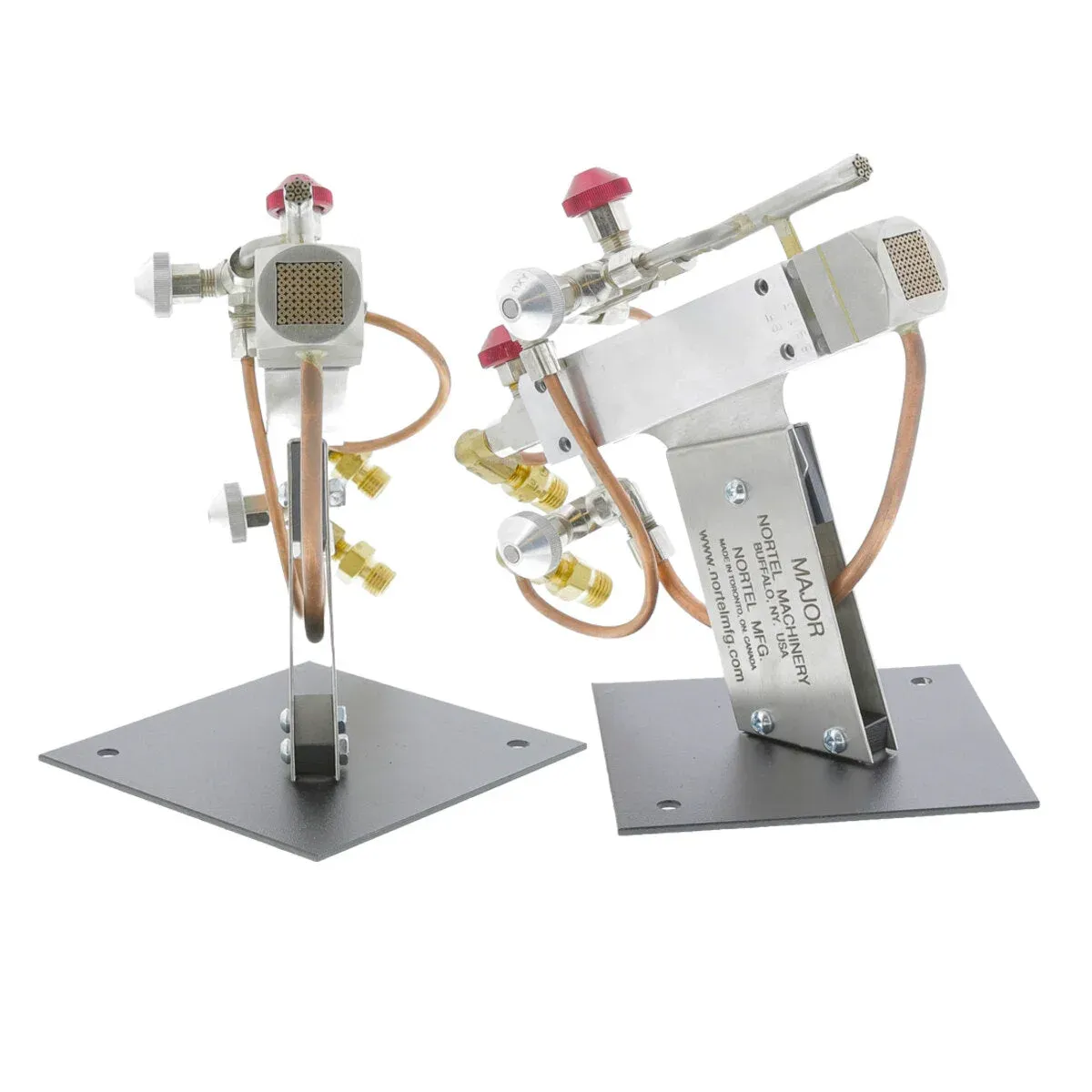
The Nortel Major is a larger two-stage, surface-mix bench torch, a 64-port bottom head with a bushy flame up to 1.5in across plus a top-mounted Minor for fine work, built for borosilicate and bigger beads when the smaller Nortels run out of heat.
Specs
- Mix type
- Surface mix
- Mount
- Bench
- Oxygen (estimate)
- n/a
- Fuel
- Propane, Natural gas
- Skill level
- Intermediate
- Glass
- Soft, Boro
- Best for
- Boro, Larger beads, General
- Price
- ~$492 (reference)
- Jets
- 64
- Stages
- 2
Treat the oxygen figure as a rough sizing estimate, not a specification. Depending on the model it may be manufacturer full-flame consumption, a converted flow figure, or a documented estimate, and delivered pressure and purity matter as much as flow. What actually drives a torch choice is the glass, the work, and the flame, so size your oxygen supply after you pick the torch. Prices may be manufacturer list prices or observed dealer references. Use the evidence label and sources below, then confirm the exact configuration before buying.
Overview
The Nortel Major is the larger bench burner in Nortel’s line: a 64-port bottom head that throws a bushy flame up to about 1.5 inches across, topped with a Minor for small, detailed flames and independent valve controls for each. It’s the torch you step up to when the Minor or Mid Range runs out of heat and you want to work borosilicate and larger beads without leaving the easy-going Nortel family.
Two flames in one torch
The Major’s appeal is having both heat and detail on tap. The 64-port bottom head is a surface-mix flame built for soaking heat into bigger or thicker glass, while the top-mounted Minor gives you a small, focused flame for fine work, and because each has its own valve control, you can run them independently or together. Like the rest of the Nortel bench line it’s surface mix, so the flame stays clean, quiet, and color-friendly; see surface mix vs premix torches for why that matters.
Who the Major is for
This is an intermediate torch aimed at borosilicate, larger beads, and general work. It’s more burner than a pure beginner needs, but it’s a natural home for someone who’s outgrown a small starter and wants room to push into boro. If your work is still all fine detail, a Minor covers that for less; if you’re heading toward heavier boro, the Major is a credible step up the line. Not sure which glass you’re committing to? See soft glass vs boro vs quartz.
Glass, fuel, and oxygen
The Major comfortably runs soft glass and borosilicate. It burns propane or natural gas with oxygen; Nortel’s suggested regulator pressures are roughly 2 to 6 psi for propane, 1/4 to 2 psi for natural gas, and 5 to 8 psi for oxygen. Those are line pressures, not flow rates, a bigger flame naturally draws more oxygen than a Minor, but Nortel doesn’t publish the Major’s exact LPM, so size your oxygen supply against the work you actually do. See how many LPM does my torch need.
Where it sits in the Nortel line
The Major is the big two-part surface-mix bench burner above the Mid Range. Its 64-port head is the same one Nortel uses on the Multimix 8x8 hand torch. For a different mix of versatility and oxygen efficiency at a similar level, compare the Red Max; for the line’s top-end boro heat, see the Rocket.
Before you buy
Budget for the whole system, not just the torch: oxygen (a concentrator or tanks), the correct propane or natural-gas regulator, flashback protection matched to your torch and gas supply, didymium or boro-rated eyewear matched to your glass, and ventilation. New to plumbing a torch? Start with the fittings, hoses & connectors guide and the glass torch safety setup guide.
Editor’s note: spec details reflect Nortel’s own materials for the Major (the 64-port head, flame size, and suggested pressures). Nortel doesn’t publish the Major’s exact oxygen flow (LPM) or current pricing, so confirm those specifics with Nortel before purchasing.
Fit and tradeoffs
Best for: Intermediate makers doing borosilicate, larger beads, and general work who want more heat than a Minor or Mid Range, with a detailed top flame on tap.
Not for: Pure pinpoint detail-only work, or the largest production boro, a Minor handles fine detail, and dedicated production burners run hotter.
Pros
- + Large 64-port bottom head with a bushy flame up to 1.5in across
- + Top-mounted Minor gives a small, detailed flame with independent valve control
- + Surface-mix design: clean, quiet, color-friendly
- + Strong choice for borosilicate and larger beads
Cons
- − Bigger flame means a bigger oxygen appetite than the smaller Nortels
- − Exact oxygen LPM isn't published, confirm with Nortel before sizing a supply
- − More torch than a pure beginner needs
Flame notes
Large surface-mix bench burner: a 64-port bottom head (bushy flame up to 1.5in diameter) with a top-mounted Minor for small/detailed flames; independent valve controls. Great for borosilicate. Suggested pressures propane 2-6 psi, natural gas 1/4-2 psi, oxygen 5-8 psi.
Maker
Nortel Manufacturing
Canada · Founded 1967
Focus: Soft, Boro, Beginner
Toronto manufacturer founded by Peter Norton. The current mounted line is surface mix; selected hand torches and optional top burners are premix.
Related reading
Compared with
Head-to-head guides that put the Major against other torches.
FAQ
- What makes the Major bigger than the Minor or Mid Range?
- The Major's bottom head carries 64 ports and throws a bushy flame up to about 1.5 inches across, considerably more heat than the smaller Nortels. It also adds a top-mounted Minor for small, detailed flames, with independent valve controls for each.
- Is the Major good for boro?
- Yes, Nortel pitches it as great for borosilicate, and it handles larger beads and general work too. For the very largest or thickest boro, you'd look at the Rocket or a dedicated production burner.
- What pressures does the Major use?
- Nortel suggests roughly 2 to 6 psi for propane, 1/4 to 2 psi for natural gas, and 5 to 8 psi for oxygen. Those are line pressures, not flow rates, so they don't tell you the torch's LPM draw.
- Does the Major have two flames?
- Effectively yes: a large 64-port bottom flame for heat and a small top-mounted Minor flame for detail, each with its own valve control, so you can run a soaking flame and a fine flame from one torch.