Nortel Minor Bench Burner: the 7-port surface-mix starter most studios run
Nortel Minor · Bench torch · Surface mix
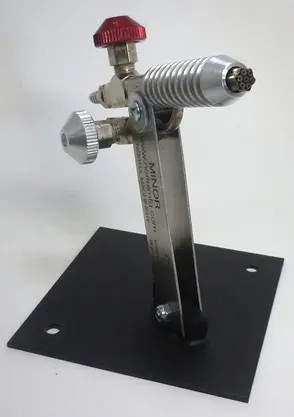
The Nortel Minor is a single-stage, 7-port surface-mix bench torch with a 1/8in to 3/4in flame, about $224 in our catalog, and the torch most beginners learn on.
Specs
- Mix type
- Surface mix
- Mount
- Bench
- Oxygen (estimate)
- ~9 LPM
- Fuel
- Propane, Natural gas
- Skill level
- Beginner, Intermediate
- Glass
- Soft, Boro
- Best for
- Beads, Small boro, Starter
- Price
- ~$224 (reference)
- Jets
- 7
- Stages
- 1
Documented estimate
Treat the oxygen figure as a rough sizing estimate, not a specification. Depending on the model it may be manufacturer full-flame consumption, a converted flow figure, or a documented estimate, and delivered pressure and purity matter as much as flow. What actually drives a torch choice is the glass, the work, and the flame, so size your oxygen supply after you pick the torch. Prices may be manufacturer list prices or observed dealer references. Use the evidence label and sources below, then confirm the exact configuration before buying.
Overview
The Nortel Minor is the small, affordable bench burner that a huge number of lampworkers light first and, just as often, keep lighting for years. It is a single-stage, surface-mix torch with a 7-port stainless front end and precision needle valves, its flame runs from about 1/8 inch to 3/4 inch, and our catalog carries it at about $224. It is built for beads, small sculpture, and small borosilicate, it is the wrong torch for large tubing or thick solid work, and it has a reputation as a reliable, near-indestructible classic that turns up in studios and classrooms everywhere. If you are starting out and want a low-risk, well-understood torch, the Minor is the default answer.
What the Minor’s flame gives you
The Minor is surface mix, meaning fuel and oxygen meet at the face of the torch rather than premixing inside the body. The practical payoff is a clean, quiet, color-friendly flame that’s easy to read and forgiving to learn on. Its precision needle valves let you dial a tight flame from about 1/8 inch up to 3/4 inch, small enough for fine bead and detail work, with enough control that uneven technique is punished less than on a sharp, high-output torch. For the wider context on why surface mix matters, see surface mix vs premix torches.
Who the Minor is for
This is a beginner-to-intermediate torch aimed at beads, small sculpture, and small boro. It’s about as gentle an on-ramp as the craft offers, which is why it’s such a common first recommendation, and why it shows up on our list of the best beginner glass torches. It’s not just a starter, though: plenty of soft-glass artists run a Minor for a lifetime because it simply does what they need and never gets in the way.
Glass, fuel, and oxygen
The Minor comfortably handles soft (soda-lime) glass and small borosilicate, beads, small sculpture, and marbles up to roughly 3 inches. It isn’t built for large boro tubes or thick solid work, which need more heat than a single-stage burner delivers. It burns propane or natural gas with bottled oxygen or an oxygen concentrator, and its small flame keeps oxygen demand modest.
Nortel publishes no LPM figure for the Minor. Our catalog carries about 9 LPM as our own documented estimate, taken at the largest usable flame rather than at a working bead flame, so treat it as a sizing figure and nothing more. Size your supply against the work you actually do; our guides on how many LPM your torch needs and oxygen concentrator vs tanks walk through the math.
Where it sits in the Nortel line
The Minor is the bottom of Nortel’s bench range and the reference point the rest of the line is described against. The closely related Mega Minor is the same 7-port face with slightly larger ports and a flame to 7/8in, which is the usual step for someone heading toward boro. When you want more flame, the Mid Range adds size while staying easy to learn on, and the Red Max adds a second head and a lot more versatility, see our Red Max vs Minor comparison. For the whole line in one place, including the hand torches, read our Nortel torch lineup guide. Thinking about a different brand’s beginner torch? Compare the Minor vs the Carlisle Mini CC.
Before you buy
Budget for the whole system, not just the torch: oxygen (a concentrator or tanks), the correct propane or natural-gas regulator, flashback protection matched to your torch and gas supply, didymium or boro-rated eyewear matched to your glass, and ventilation. New to plumbing a torch? Start with the fittings, hoses & connectors guide and the glass torch safety setup guide.
Editor’s note: spec details reflect Nortel’s own materials for the Minor (flame size and surface-mix front end). The oxygen figure is our own estimate, not a Nortel number, and the price we show is a reference figure gathered from the market rather than a published Nortel list, so confirm both with Nortel before purchasing.
Fit and tradeoffs
Best for: Beginners and hobbyists doing beads, small sculpture, and small boro who want a forgiving, low-cost first bench torch that runs on a modest oxygen supply.
Not for: Large boro tubes, thick solid work, or production heat, step up to a Major, Red Max, or Rocket for that.
Pros
- + Affordable, ubiquitous entry point, easy to learn on and easy to resell
- + 7-port surface-mix front end with precision needle valves for fine control
- + Tight 1/8in-to-3/4in flame suits beads, detail, and small boro
- + Reliable, near-indestructible build with decades of studio history
- + Runs propane or natural gas on bottled oxygen or a concentrator
Cons
- − Single-stage, not built for large boro or production heat
- − Nortel publishes no oxygen figure; our own estimate is about 9 LPM at the largest usable flame, so size a concentrator against the work you actually do
Flame notes
Surface mix, 7-port stainless front end with precision needle valves; flame 1/8in to 3/4in. Reliable, near-indestructible classic starter used by most studios; for beads, small sculpture and marbles up to ~3in. Runs propane or natural gas with bottled oxygen or a concentrator.
Maker
Nortel Manufacturing
Canada · Founded 1967
Focus: Soft, Boro, Beginner
Toronto manufacturer founded by Peter Norton. The current mounted line is surface mix; selected hand torches and optional top burners are premix.
Related reading
- Nortel Minor vs Carlisle Mini CC: Which Beginner Torch Wins?
- Nortel Red Max vs Minor: Which Affordable Torch to Buy?
- Best Beginner Glass Torch: Forgiving First Torches That Won't Hold You Back
- Surface Mix vs Premix Torches: Flame, Noise, and Cost
- How to Choose a Glass Torch: The Complete Buyer's Guide
- Best Torch for Making Glass Beads: Gentle Flames for Soft-Glass Lampwork
Compared with
Head-to-head guides that put the Minor against other torches.
- Bethlehem Alpha vs Nortel Minor: Two Entry Surface-Mix Bench Torches
- GTT Bobcat vs Nortel Minor: Which First Serious Torch to Buy
- GTT Cricket vs Nortel Minor: The Entry Bench Torch Decision
- Nortel Minor vs Carlisle Mini CC: Which Beginner Torch Wins?
- Nortel Minor vs Mega Minor: Which Starter Bench Torch to Buy
- Nortel Red Max vs Minor: Which Affordable Torch to Buy?
FAQ
- Is the Nortel Minor good for beginners?
- Yes, and it is one of the most common beginner bench torches in the craft. The flame is forgiving, the price is low, about $224 in our catalog, and the torch is reliable enough that plenty of working artists keep using one for years rather than trading up. Most teaching studios and classrooms have at least one bolted to a bench. Confirm the current price and options with Nortel.
- What oxygen does the Nortel Minor need?
- Nortel does not publish an LPM figure for the Minor, so every number you see, ours included, is an estimate. Our catalog places it at about 9 LPM, and that is a ceiling at the largest usable flame rather than what a small bead flame draws. Nortel says the torch runs on bottled oxygen or a concentrator without stating a size in the materials we have, so size your supply against the flame you actually run and check it with Nortel.
- Nortel Minor or Mega Minor?
- Same 7-port surface-mix burner, different port sizing. The Mega Minor's ports are slightly larger, which Nortel says runs hotter and uses oxygen more efficiently, and its flame reaches 7/8in against the Minor's 3/4in, which is why it is the better pick if you already know you want borosilicate. Our catalog prices them at $224 and $268. For soft glass and a lowest-risk start, the Minor is still the one. Confirm current specs with Nortel.
- Does the Nortel Minor run on natural gas?
- Yes. Our catalog lists the Minor for propane or natural gas with oxygen, which is why it turns up plumbed into a house line as well as running off a propane bottle. Whether an unboosted house line feeds it properly depends on your pipe size, the length of the run, and what your utility delivers, so confirm the pressure your torch wants with Nortel and with its manual before you plumb anything.
- What can the Minor melt?
- It is built for soft (soda-lime) glass and small borosilicate: beads, small sculpture, and marbles up to about 3 inches. For large boro tubes or thick solid work you would want a larger Nortel such as the Major, Red Max, or Rocket.
- Is the Minor surface-mix or premix?
- The Minor is a surface-mix burner: fuel and oxygen meet at the 7-port face rather than premixing inside the body. That gives it a clean, quiet, color-friendly flame. Forum posts calling it premix are repeating an old error; every Nortel bench burner is surface mix.
- Minor or Carlisle Mini CC?
- Both are classic beginner bench torches, and the choice comes down to flame character, glass range, and what you can actually get hold of. Our Nortel Minor versus Carlisle Mini CC comparison, linked below, walks through it.