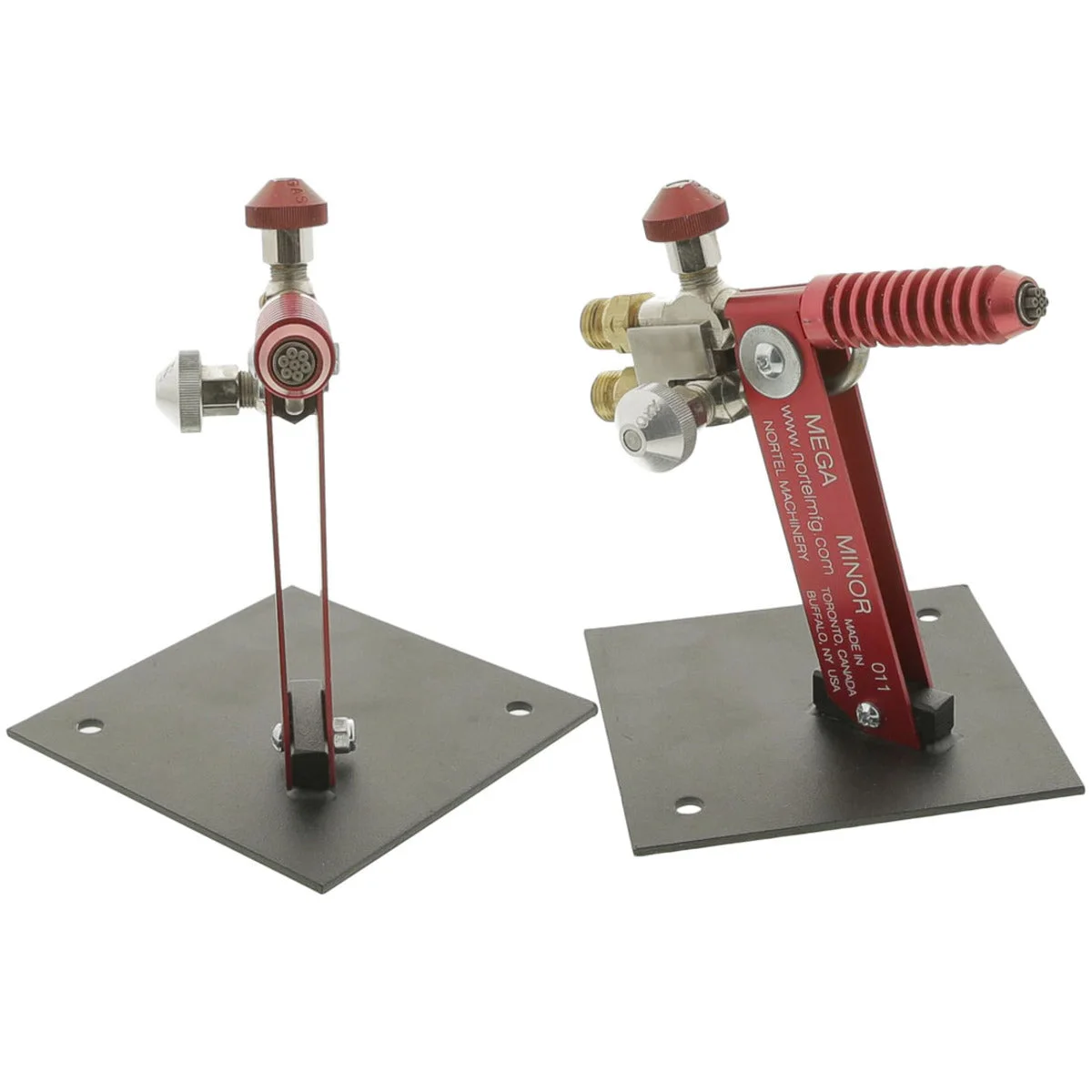
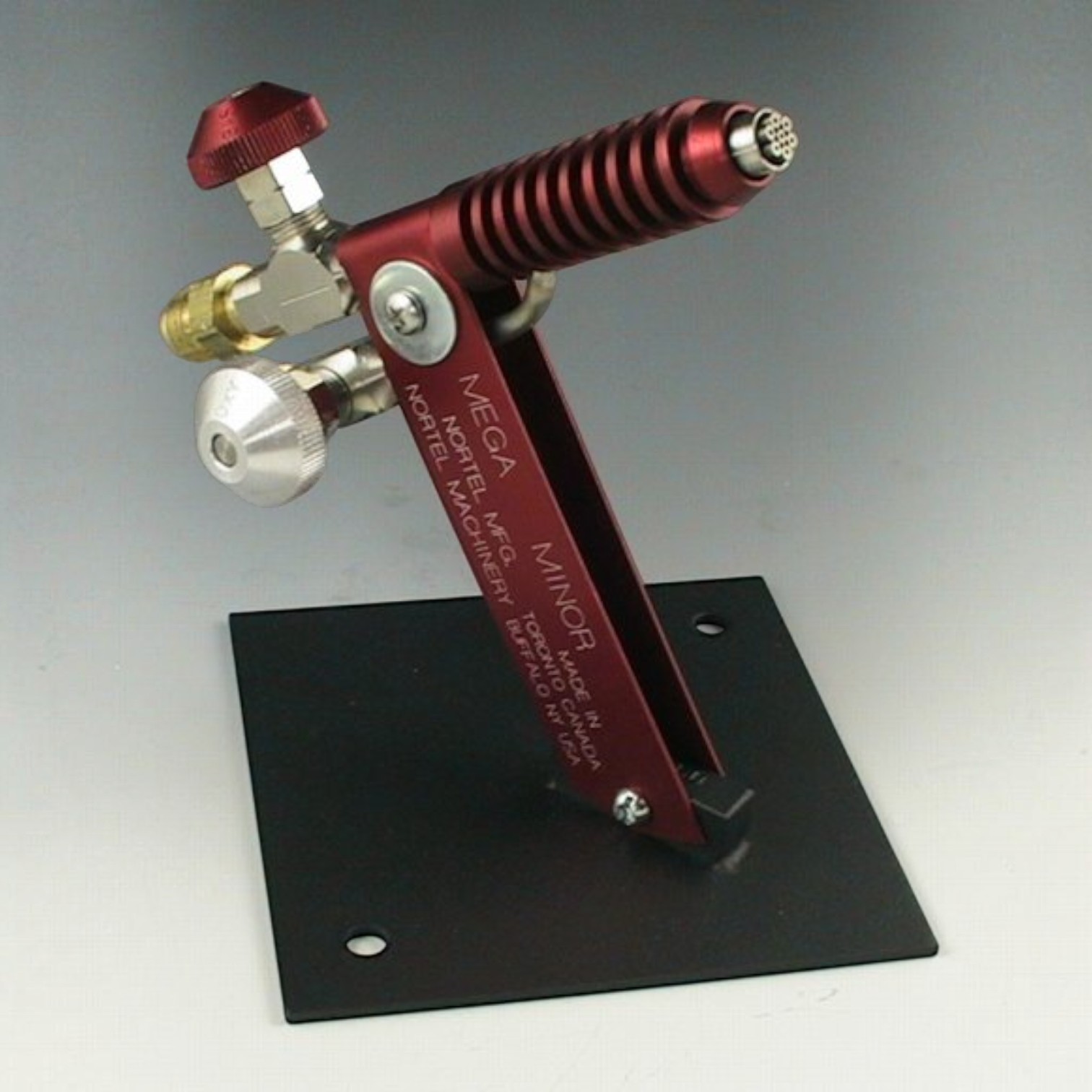
Nortel Mega Minor Glass Torch
Surface mix
$349
US reference price
Bench configuration shown.
Overview
Best for: Beads, Soft glass, Small boro
- Mount
- Bench
- Fuel
- Propane, Natural gas
- Oxygen (estimate)
- ~9 LPM
Specs
The Nortel Mega Minor is a 7-port surface-mix bench burner like the Minor but with slightly larger ports for hotter temperatures and more efficient oxygen use, a forgiving, versatile small-to-medium torch for beads, soft glass, and small boro that also serves as the Red Max top fire.
Beginners and intermediates who want a Minor-style flame with a bit more heat and oxygen efficiency for beads, soft glass, and small boro.
- Jets
- 7
- Stages
- 1
- Mount
- Bench
- Mix
- Surface mix
Specs
- Mix type
- Surface mix
Manufacturer page · checked 2026-09-28 · source
- Mount
- Bench
- Oxygen (estimate)
- ~9 LPM
Documented estimate · editor's estimate, not a maker figure · checked 2026-07-18Oxygen use at the largest usable flame, not a minimum.
- Fuel
- Propane, Natural gas
Manufacturer page · checked 2026-09-28 · source
- Skill level
- Beginner, Intermediate
- Glass
- Soft, Boro
- Best for
- Beads, Soft glass, Small boro
- Price
- ~$349 (reference)
Manufacturer page · confirmed · checked and price captured 2026-10-17 · source
- Jets
- 7
Manufacturer page · checked 2026-09-28 · source
- Stages
- 1
Manufacturer page · checked 2026-09-05 · source
Figures come from Nortel's own pages and manuals where we have them; the oxygen figure is a rough estimate, not a specification. Confirm the current spec with Nortel before you buy.
How we source these figures
Treat the oxygen figure as a rough sizing estimate. Depending on the model it may be manufacturer full-flame consumption, a converted flow figure, or a documented estimate, and delivered pressure and purity matter as much as flow. What actually drives a torch choice is the glass, the work, and the flame, so size your oxygen supply after you pick the torch.
Prices may be manufacturer list prices or observed dealer references. Where a cell carries an evidence line it says where the figure came from, the date we checked it, and links the source where we hold one; a cell without one rests on the sources at the foot of the page. On a phone those lines show while this note is open. Confirm the exact configuration with Nortel before buying.
Spec provenance: 5 of 8 spec fields on this page cite the manufacturer's own pages or manuals, and 1 is a documented estimate of ours.
Overview
The Nortel Mega Minor is, essentially, a Minor turned up a notch. It uses the same 7-port stainless surface-mix layout but with slightly larger ports, which gives it hotter temperatures and more efficient oxygen use, and a flame that runs from a needle point up to about 7/8 inch. The result is a forgiving, versatile small-to-medium torch that’s good for small boro while staying great on soft glass, and that also pulls double duty as the Red Max top fire.
What the Mega Minor gives you
If you know the Minor, you know most of the Mega Minor: it’s surface mix, so fuel and oxygen meet at the face for a clean, quiet, color-friendly flame, and it learns and behaves the same way. The larger ports are the difference, they let it run hotter and lean on oxygen more efficiently, nudging it a step toward boro without losing the easy soft-glass character. For the background on surface-mix flames, see surface mix vs premix torches.
Who the Mega Minor is for
This is a beginner-to-intermediate torch for beads, soft glass, and small boro, a good pick for someone who likes the Minor’s simplicity but wants a bit more heat and efficiency. It handles beads, small sculpture, and marbles up to roughly 3 inches, and it’s a sensible name on our best beginner glass torch shortlist for makers leaning slightly toward boro. Choosing between the small Nortels and a Carlisle? See Nortel Minor vs Carlisle Mini CC.
Glass, fuel, and oxygen
The Mega Minor runs soft glass and small boro, burning propane or natural gas with bottled oxygen or a concentrator. Its more efficient oxygen use is a selling point, but Nortel doesn’t publish an exact LPM figure, so size your oxygen supply against your work; see how many LPM does my torch need.
Where it sits in the Nortel line
The Mega Minor sits just above the Minor and frequently rides on top of the Red Max as its top fire, so the flame behavior carries across the line. When you want a larger main flame, look at the Mid Range or Major; coming from a Minor, our Red Max vs Minor comparison frames the upgrade path.
Before you buy
Budget for the whole system, not just the torch: oxygen (a concentrator or tanks), the correct propane or natural-gas regulator, flashback protection matched to your torch and gas supply, didymium or boro-rated eyewear matched to your glass, and ventilation. New to plumbing a torch? Start with the fittings, hoses & connectors guide and the glass torch safety setup guide.
Editor’s note: spec details reflect Nortel’s own materials for the Mega Minor (the 7-port head, flame size, and its role as the Red Max top fire). Nortel doesn’t publish the Mega Minor’s exact oxygen flow (LPM). The price is the US-dollar figure on Nortel’s own store, read 2026-10-17; Nortel prices in Canadian dollars, so its US figure is a currency conversion that moves with the exchange rate. Confirm current specifics with Nortel before purchasing.
Fit and tradeoffs
Best for: Beginners and intermediates who want a Minor-style flame with a bit more heat and oxygen efficiency for beads, soft glass, and small boro.
Not for: Large boro tubes, thick solid work, or production, step up to a Major, Red Max, or Rocket for serious heat.
Pros
- + 7-port surface-mix flame with slightly larger ports for hotter temps than the Minor
- + More efficient oxygen use than the standard Minor
- + Flame from a needle point up to about 7/8in
- + Good for small boro while staying great on soft glass
- + Doubles as the Red Max top fire, so skills and parts carry over
Cons
- − Still a single small head, not built for large boro or production heat
- − Exact oxygen LPM isn't published, confirm with Nortel before sizing a supply
Reader reviews
No reader reviews yet. If you have worked on this torch, yours would be the first, and it is read by the editor before it appears.
Write a review of the Nortel Mega Minor
Flame notes
Surface mix, 7-port stainless burner like the Minor but with slightly larger ports for hotter temperatures and more efficient oxygen use; flame from a needle point to 7/8in. Good for boro while still great on soft glass; beads, small sculpture, marbles up to ~3in. Often paired as the Red Max top fire.
Manuals & instructions
Manufacturer documentation on the maker's own site, which holds the current revision.
Maker
Nortel Manufacturing
Canada · Founded 1967
Focus: Soft, Boro, Beginner
Toronto manufacturer founded by Peter Norton. The current mounted line is surface mix; selected hand torches and optional top burners are premix.
Related reading
Compared with
Head-to-head guides that put the Mega Minor against other torches.
- Bethlehem Alpha vs Nortel Mega Minor: Entry Bench TorchesSee both side by side
- Bethlehem Star vs Nortel Mega Minor: Which Step-Up Bench TorchSee both side by side
- Nortel Mega Minor vs GTT Bobcat: Which Entry Bench Torch to BuySee both side by side
- Nortel Minor vs Mega Minor: Which Starter Bench Torch to BuySee both side by side
FAQ
- How is the Mega Minor different from the Minor?
- It's the same 7-port surface-mix layout as the Minor but with slightly larger ports, which gives it hotter temperatures and more efficient oxygen use. The flame runs from a needle point up to about 7/8 inch, a touch larger than the Minor's 3/4 inch.
- Is the Mega Minor good for boro?
- Nortel describes it as good for boro while still being great on soft glass, beads, small sculpture, and marbles up to about 3 inches. For large boro tubes or thick solid work, step up to a Major or Rocket.
- Can the Mega Minor be a Red Max top fire?
- Yes, Nortel often pairs the Mega Minor as the top burner on the Red Max. It works as a standalone bench torch too, so it pulls double duty.
- Is the Mega Minor surface-mix or premix?
- It's a surface-mix burner: fuel and oxygen meet at the 7-port face rather than premixing inside, for a clean, quiet, color-friendly flame.
Researched and edited by Joe Blanchard, sixteen years on the distribution side of the glass industry.