Nortel Manufacturing is a Toronto burner maker, and for a lot of lampworkers it is the first torch they ever lit. The company was established in 1967 and traces its most famous product, the Minor bench burner, to a design its founder developed decades earlier to make a home lampwork studio affordable. That heritage is a big part of why a Nortel Minor is still the torch you find bolted to the bench in teaching studios and bead makers’ garages across North America. It is reliable, repairable, and near indestructible, and it built the reputation the rest of the line rests on. If you want the model-by-model buyer’s view rather than this long walk through the line, the Nortel maker page linked above is the faster route: it carries the whole current lineup in one spec table, with prices, jets, oxygen estimates, and the questions buyers ask most.
The confusion starts once you look past the Minor. Nortel sells sixteen distinct torch models across bench burners and hand torches, the names (Minor, Mega Minor, Mid Range, Major, Red Max, Rocket, Ranger, Multimix, Unitorch, Twin Fuel) do not tell you where a model sits in the line, and one of the most persistent beliefs about the entry torch is simply wrong. This guide lays the whole lineup out in one place: what makes a Nortel a Nortel, which models are bench burners and which are hand torches, which are surface mix and which are premix, what each one costs on the street, and who each is for. Every spec here comes from Nortel’s own materials cross-checked against our catalog, and where a figure is not published we say so rather than guess. Prices are street estimates and move around; confirm current numbers before you buy.
What makes a Nortel a Nortel
Start with the myth, because it trips up more buyers than any other single point. Forum threads and secondhand advice often describe the Nortel Minor as a premix torch. It is not. Every Nortel bench burner is surface mix, the Minor included. Fuel and oxygen stay separate inside the torch and only combine at the face, which is the forgiving, flashback-resistant design that makes these torches such good learning tools. If someone tells you the Minor runs a premixed center fire, they are repeating an old error; the community-level confusion between premix and surface mix is a known and recurring one, and Nortel’s own model descriptions settle it. Premix does exist in the Nortel catalog, but only in the hand torches covered further down, and as an optional top-fire accessory, never as the standard heart of a Minor or any other bench burner.
The signature idea in the bench line is the two-part, interchangeable top-fire system on the bigger burners. On a Red Max, Major, Mid Range Plus, or the Rocket accessory, the large lower head does the bulk heating while a second burner mounts on top for small, detailed flames, and the two can run at once. The clever part is that the top fire is a module, but which modules Nortel lists depends on the burner. The Major page lists a Minor top; the Mid Range Plus page lists a Minor or Mega Minor; the Red Max page adds a Premix head that takes National-style N11 and N3 tips; and the Rocket has its own optional premix accessory burner with a quiet N11 multi-orifice tip. Check the page for your model rather than assuming the full menu. That premix option is where premix genuinely enters the bench story, and only there: as an optional accessory on the models Nortel lists it for, chosen by the buyer, not built into the base torch. Pick a surface-mix top and the whole burner is surface mix end to end.
The genuine premix members of the lineup are hand torches: the Unitorch in its six, nine, and twelve tip forms, and the Twin Fuel Handtorch. Those are true premix designs where fuel and oxygen mix inside the torch before they reach the tip, which is a different and less forgiving arrangement suited to their scientific and high-temperature jobs. Everything else Nortel makes, bench or hand, is surface mix.
Two more traits matter to buyers. First, Nortel torches use precision needle valves for fuel and oxygen, which is a large part of why they hold a tiny, stable flame so well and why they are prized for detail and bead work. Second, Nortel tends to state pressures more often than flow rates. Its model pages list suggested gas and oxygen psi far more consistently than they list oxygen consumption in liters per minute, so this guide reports pressure where Nortel does and leaves the LPM column blank wherever Nortel does not publish a usable-flame figure. We do not invent one to fill the gap.
On fuel, every Nortel in this guide runs on propane or natural gas paired with oxygen. One model adds hydrogen: the Twin Fuel Handtorch, whose twin-fuel valves are built for it. (Nortel’s Red Max page carries a blanket line that all Nortel torches can run hydrogen, but the individual product pages, including the Mid Range Plus, list only natural gas or propane with oxygen, so we scope hydrogen to the torch documented for it.) Do not assume hydrogen or any other fuel on the rest of the line; where a model is not listed for a fuel, treat it as not supported.
The full Nortel lineup
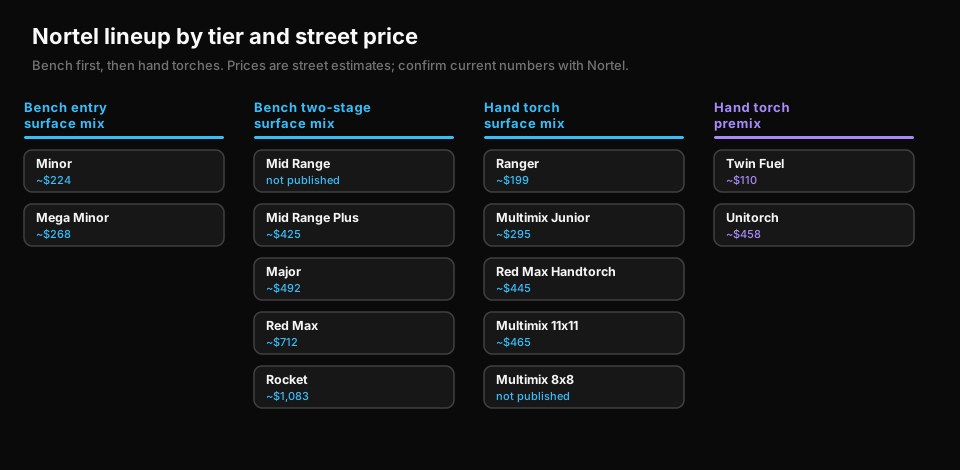
Sixteen models, bench burners first, then hand torches. Oxygen, where shown, is a maximum usable-flame figure in LPM; prices are street estimates.
| Model | Type | Stages | Jets | Max usable O2 (LPM) | Street price | Best for |
|---|---|---|---|---|---|---|
| Minor | Bench | 1 | 7 | ~9 (our estimate) | ~$224 | Classic starter; beads, small sculpture, marbles |
| Mega Minor | Bench | Not published | 7 | ~9 (our estimate) | ~$268 | Hotter Minor; also the common Red Max top fire |
| Mid Range | Bench | 1 | Not published | Not published | Not published | Step up from the Minor; bigger flame, easy to learn |
| Mid Range Plus | Bench | 2 | Not published | Not published | ~$425 | Mid Range with a Minor or Mega Minor top fire |
| Major | Bench | 2 | 64 | Not published | ~$492 | Bushy bottom flame plus detail top fire; boro |
| Red Max | Bench | 2 | 45 | Not published | ~$712 | Wide-range two-head bench workhorse |
| Rocket | Bench | 2 | Not published | Not published | ~$1,083 | Large boro and production; geared tilt, center fire |
| Ranger | Hand | 1 | Not published | Not published | ~$199 | Minor features in a hand torch |
| Multimix Junior | Hand | 1 | Not published | Not published | ~$295 | Mid Range flame character, hand held |
| Red Max Handtorch | Hand | 1 | 45 | Not published | ~$445 | Red Max flame pattern in the hand |
| Multimix 11x11 | Hand | 1 | 121 | Not published | ~$465 | Large surface-mix hand torch |
| Multimix 8x8 | Hand | 1 | 64 | Not published | Not published | Major-head flame, hand held |
| Unitorch | Hand | Not published | Not published | Not published | ~$458 | Six-tip premix; scientific and lathe work |
| Unitorch-9 | Hand | Not published | Not published | Not published | Not published | Nine-tip premix; longer reach for an intense narrow band |
| Unitorch-12 | Hand | Not published | Not published | Not published | Not published | Twelve-tip premix; the widest of the Unitorch heads |
| Twin Fuel Handtorch | Hand | 1 | Not published | Not published | ~$110 | Premix; quartz, lathe boosting, high-temp |
A note on the two oxygen figures. The Minor and Mega Minor both show roughly 9 LPM, and that number is our own comparative placement, not a Nortel specification. We put both burners just above a GTT Bobcat’s 8.5 LPM maximum flame and just below a GTT Lynx’s 9.5, because that is where they sit in real use. Nortel does not publish a usable-flame LPM for either one, so treat the ~9 as our editorial estimate rather than a measured spec. Every other model reads Not published because no figure exists in our catalog to report.
Tier by tier: every model
Bench, single-stage entry. The two seven-port Minors anchor the line and are where most lampworkers start.
Minor
~$224 · 7 jets · 1 stage · ~9 LPM max O2 (our estimate) · surface mix
The Minor is the anchor of the whole line: a seven-port, single-stage surface-mix bench burner with a flame from about an eighth of an inch to three quarters of an inch, run on propane or natural gas with oxygen from a tank or a concentrator. It is the reliable, near indestructible classic that most studios and teachers reach for, aimed at beads, small sculpture, and marbles up to roughly three inches. Around $224, it is where a huge share of lampworkers start, and its precision needle valves are the reason it holds a fine flame so well. The ~9 LPM figure is our own comparative placement, not a Nortel specification.
Mega Minor
~$268 · 7 jets · stages not published · ~9 LPM max O2 (our estimate) · surface mix
The Mega Minor is the Minor’s slightly hotter twin: the same seven-port surface-mix front end but with slightly larger ports for higher temperatures and more efficient oxygen use, giving a flame from a needle point up to about seven eighths of an inch. It handles boro a little more comfortably than the Minor while staying excellent on soft glass, and it doubles as the most common top-fire head on the Red Max. Street price is near $268, and its ~9 LPM figure, like the Minor’s, is our comparative placement rather than a Nortel spec.
Bench, two-stage. These are the bigger burners, several built around the interchangeable two-part top-fire system.
Mid Range
Price not published · jets not published · 1 stage · O2 not published · surface mix
The Mid Range is the single-burner step up from the Minor: a stainless surface-mix burner with a larger flame up to about an inch across, still easy to learn on and happy with soft or hard glass. Nortel publishes no jet count for it, and says three concentrators are required for optimum performance, more oxygen than its size suggests. Nortel does not list a price in our catalog, so we leave it as not published rather than estimate one; suggested pressures run roughly a quarter to five psi on gas and five to fifteen psi on oxygen. Fit it with a top-mounted Minor or Mega Minor and it becomes the separate Mid Range Plus below.
Mid Range Plus
~$425 · jets not published · 2 stages · O2 not published · surface mix
The Mid Range Plus takes a Mid Range body and adds a top-mounted burner, a Minor or a Mega Minor, so you get a broad bottom flame up to about an inch plus a small detailed top flame, and Nortel says the two can run together. Its page lists natural gas or propane with oxygen. Street price is around $425, an approximate reference we have not confirmed against current listings.
Major
~$492 · 64 jets · 2 stages · O2 not published · surface mix
The Major is a large surface-mix bench burner built around a sixty-four-port bottom head that throws a bushy flame up to about an inch and a half wide, with a top-mounted Minor for small, detailed work and independent valve control over each. It is a strong borosilicate torch at roughly $492. Nortel gives suggested pressures (propane two to six psi, natural gas about a quarter to two psi, oxygen five to eight psi) but no usable-flame LPM, so the oxygen column stays blank.
Red Max
~$712 · 45 jets · 2 stages · O2 not published · surface mix
The Red Max is the two-head bench workhorse and the clearest expression of the interchangeable top-fire idea. Nortel labels its lower head forty-five-port (the same page describes rings of sixteen and twenty-seven, which total forty-three, a discrepancy we report rather than resolve), giving a flame to about an inch and a quarter, and on top sits your choice of a Minor, a Mega Minor, or a Premix head taking N11 and N3 tips. Between the two flames it covers an unusually wide range, and at about $712 it is a lot of torch for the money. We compare it directly against the Minor in a dedicated guide linked below.
Rocket
~$1,083 · jets not published · 2 stages · O2 not published · surface mix
The Rocket tops the bench line: a two-stage surface-mix burner with a separately controlled center-fire jet, precision needle valves, and a flame from small up to about two inches wide, mounted with geared tilt control. An optional premix accessory burner (a quiet multi-orifice tip that accepts National-style tips) and a foot pedal are available. Suggested pressures are oxygen seven to fifteen psi and fuel two to six psi. At roughly $1,083 it is aimed at large boro and production work; the jet count is not listed in our catalog, so that cell stays blank.
Hand torches, surface mix. Nortel’s surface-mix flames in a hand-held body, from Minor-grade control up to large-format output.
Ranger
~$199 · jets not published · 1 stage · O2 not published · surface mix (hand torch)
The Ranger puts the Minor’s character into a hand torch: a single-stage surface-mix design with the same precision needle valves, and valve bodies that rotate to suit the operator’s grip. At about $199 it is the natural pick for someone who wants Minor-grade control but needs to move the flame around rather than work at a fixed bench.
Multimix Junior
~$295 · jets not published · 1 stage · O2 not published · surface mix (hand torch)
The Multimix Junior is a stainless surface-mix hand torch tuned to the flame character of the Mid Range bench burner: a fully surface-mix flame with fine control and a tight pattern, on a lightweight body with rotating valve bodies. It runs near $295 and suits detailed offhand work.
Red Max Handtorch
~$445 · 45 jets · 1 stage · O2 not published · surface mix (hand torch)
The Red Max Handtorch carries the bench Red Max’s forty-five-port flame pattern (the center ring of sixteen surrounded by twenty-seven) into a wooden-gripped hand torch with a flame up to about an inch and a quarter wide. It is eighteen inches long, built for a large concentrated flame, and strong on borosilicate, at roughly $445.
Multimix 11x11
~$465 · 121 jets · 1 stage · O2 not published · surface mix (hand torch)
The Multimix 11x11 is a large surface-mix hand torch with an eleven by eleven orifice pattern, the bigger sibling of the 8x8. At about $465 it is the high-output member of the Multimix hand torches for artists who want serious flame they can carry.
Multimix 8x8
Price not published · 64 jets · 1 stage · O2 not published · surface mix (hand torch)
The Multimix 8x8 uses the same sixty-four-orifice head as the Major bench burner, in an eight by eight pattern, on a welded stainless hand torch with rotating fuel and oxygen valve bodies. It is about twenty inches long. Nortel does not list a price in our catalog, so we leave it as not published.
Hand torches, premix. The only genuine premix torches Nortel makes, for scientific and high-temperature work.
Unitorch
~$458 · jets not published · stages not published · O2 not published · premix (hand torch)
The Unitorch is the first of the genuine premix hand torches, and it is a scientific tool, not a starter: six stainless-steel tips, built for lathe work, seals, and flame cutting, and rated by Nortel for forty-millimeter quartz or seventy-five-millimeter borosilicate standard-wall tubing, around $458. Because it is premix, fuel and oxygen combine inside the torch, so it behaves differently from the surface-mix models above and rewards a careful, experienced hand.
Unitorch-9
Price not published · jets not published · stages not published · O2 not published · premix (hand torch)
The Unitorch-9 is the same premix design with nine stainless-steel tips and a roughly twenty-inch length, which lets the operator stand back from an intense narrow band of fire. Nortel lists the Unitorch hand torches for lathe work, dewars, fritted discs, round bottoms, ring seals, graded seals, glass-to-metal seals, and flame cutting, working forty-millimeter quartz or seventy-five-millimeter borosilicate standard-wall tubing. Nortel does not list a price in our catalog, so we leave it as not published.
Unitorch-12
Price not published · jets not published · stages not published · O2 not published · premix (hand torch)
The Unitorch-12 is the widest of the three, a stainless-steel manifold and nozzle tubes carrying twelve stainless-steel tips at about two pounds. It covers the same scientific work list as the six and nine tip versions, and it is the one to look at when the job is a wide band of heat across a seam rather than a concentrated point. Nortel does not list a price in our catalog, so we leave it as not published.
Twin Fuel Handtorch
~$110 · jets not published · 1 stage · O2 not published · premix (hand torch, hydrogen-capable)
The Twin Fuel Handtorch is the remaining premix design and the most specialized torch in the line: an injector-type mixer with a single finger-tip control on a lightweight aluminum handle, accepting National torch tips. Its twin-fuel valves allow combinations of natural gas, propane, and hydrogen with oxygen, which makes it well suited to quartz and high-temperature work and to boosting a lathe. At about $110 it is also the least expensive torch Nortel makes, though it is a tool for people who already know what they are doing.
Oxygen and fuel reality for the line
The honest position on Nortel and oxygen is that the company mostly talks in pressure, not flow. Its model pages give suggested gas and oxygen psi far more often than they give an oxygen consumption in LPM, and our catalog reflects that: only the Minor and Mega Minor carry an oxygen figure, and even those are our comparative estimates rather than Nortel specs. So the flow-based planning you can do for some other brands is harder here, and anyone quoting a precise LPM for a Red Max or a Rocket is almost certainly guessing.
What you can plan around is size and pressure. The Minor and Mega Minor sit comfortably on a single oxygen concentrator in the common five-to-ten LPM class, which is exactly why they are such popular first torches. As you climb into the two-head bench burners (Mid Range Plus, Major, Red Max) and the Rocket, the flame gets much larger and the oxygen appetite grows with it, to the point where a single home concentrator stops being enough for the full flame and paired concentrators, a high-output unit, or bottled oxygen become the realistic supply. Our oxygen sizing guide walks through how to match a torch to a supply, and the general rule holds here even without published Nortel LPM figures: buy the oxygen supply for the flame you actually intend to run, not the biggest flame the torch can make.
On fuel, propane and natural gas work across the whole line. Nortel’s low suggested gas pressures, often a quarter to a few psi, mean these torches are friendly to home natural-gas setups. Hydrogen is documented on exactly one model, the Twin Fuel Handtorch, whose twin-fuel valves are built for it; do not assume it on the rest. Whatever the fuel, follow Nortel’s own pressure and setup instructions for your specific model, because those instructions, not this guide, are the authority on your regulator settings.
Which Nortel for whom
If you are choosing between specific models, we have dedicated comparisons that go deeper than this overview:
- The classic starter question, and its upgrade: most people begin on the Minor, and the first real upgrade question is whether to jump to the two-head Red Max. See Nortel Red Max vs Minor.
- Cross-shopping the Minor against the popular GTT entry torch: the Bobcat is the most common alternative a beginner weighs against a Minor. See GTT Bobcat vs Nortel Minor.
- Stepping up and cross-shopping the Red Max: if you are comparing the Red Max against a Triple Mix GTT bench torch, see GTT Lynx vs Nortel Red Max.
- Minor against a small combination torch: for the cross-brand small-bench decision, see Nortel Minor vs Carlisle Mini CC.
The general shape of it: beginners and bead makers start on the Minor, or the Mega Minor for a little more heat, and many never need more. Artists who want a bigger, more flexible bench flame move to the Mid Range, then to the two-head Major or Red Max, where the interchangeable top fire earns its keep. Large-boro and production workers reach for the Rocket. Anyone who needs the flame in their hand looks at the Ranger for Minor-grade control, the Multimix family or Red Max Handtorch for more output, and the premix Unitorch or Twin Fuel Handtorch only for scientific, quartz, and high-temperature jobs where a premix torch is the right tool.
Related guides
- Nortel Red Max vs Minor
- GTT Bobcat vs Nortel Minor
- GTT Lynx vs Nortel Red Max
- Nortel Minor vs Carlisle Mini CC
- How many LPM does my torch need?
Sources
- Nortel Manufacturing Ltd., company site: https://www.nortelglass.com/
- Nortel Manufacturing Ltd., About (company history, Toronto location, founding): https://www.nortelglass.com/about-us/
- Nortel Manufacturing Ltd., torches overview: https://www.nortelglass.com/torches/
- Nortel Manufacturing Ltd., Minor bench burner: https://www.nortelglass.com/minor-bench-burner/
- Nortel Manufacturing Ltd., Red Max bench burner: https://www.nortelglass.com/red-max/
- Lampwork Etc., “Pre-mix vs Surface mix” (community discussion): http://www.lampworketc.com/forums/showthread.php?t=191042
Editor’s note: model specs, pressures, and prices here are compiled from Nortel’s own materials and our catalog (compiled 2026-07-23, not independently re-verified). Prices are street estimates and vary by dealer and by month, Nortel publishes pressures far more than oxygen flow figures so most LPM cells are left blank rather than guessed, and the two ~9 LPM figures for the Minor and Mega Minor are our comparative estimates, not Nortel specifications. Confirm current lineup, specs, and pricing with Nortel before you buy.