Glass Torch Technologies, usually shortened to GTT, is a Tioga, Pennsylvania maker of torches and burners for glass and metal work. Among boro artists it is one of the most recognized names on the bench, and its lineup runs from a tiny five-jet starter torch all the way to a four-stage production machine that is built to order. That range is exactly why buyers get confused. The company sells sixteen distinct torch models across four different burner architectures, the names (Bobcat, Lynx, Phantom, Mirage, Cobra, Quadzilla) do not tell you where a model sits in the line, and two of the best-known entry torches are not built the way most people assume.
This guide lays the whole lineup out in one place: what separates a GTT from other torches, which models are genuinely Triple Mix and which are standard surface mix, what each one costs on the street, how much oxygen each can actually use, and who each model is for. Every spec here comes from GTT’s own materials cross-checked against our catalog, and where a figure is not published we say so rather than guess. Prices are street estimates and move around; confirm current numbers with GTT before you buy.
What makes a GTT a GTT
The feature GTT is known for is Triple Mix. Most bench torches are surface-mix designs: fuel and oxygen stay separate until they leave the face of the torch and combine at the burner surface, which is forgiving and hard to flash back. GTT’s patented Triple Mix builds on that surface-mix foundation with three-stage internal mixing, which the company says produces a wider, more controllable flame with stronger reducing capability, a claim the community most often echoes around silver-bearing and reactive boro colors. It is worth reading the details in our Triple Mix explainer, because Triple Mix is a specific GTT technology, not a generic category, and it does not appear on every torch that wears the GTT badge.
That last point is the one that trips people up. GTT’s two entry torches, the Cricket and the Bobcat, are standard surface mix, not Triple Mix. Triple Mix begins one step up, at the Lynx, and runs up the line from there. GTT also offers a separate compressed-air option called 4-Way Mix, which injects compressed air alongside gas and oxygen; it is its own approach with its own trade-offs, covered in our compressed-air 4-Way Mix guide, and it is not the same thing as Triple Mix.
Two more GTT traits matter to buyers. First, GTT torches are designed to run on very low fuel pressure, as little as a quarter of a psi. That is low enough that they work on unboosted household natural gas, which typically arrives at roughly seven inches of water column, so a home studio on a gas line can often skip a booster pump entirely. Every model in the lineup runs on propane or natural gas paired with oxygen; GTT torches are not multi-fuel beyond that, so do not assume hydrogen or other gases.
Second, GTT torches are relatively thrifty with oxygen for the heat they make, which is part of why they pair well with oxygen concentrators. One important caution about the oxygen figures in this guide and on GTT’s materials: the LPM numbers are maximum-usable-flame figures, the most oxygen the biggest flame on that torch can consume, not a required setpoint. You spend most of your working life well below that ceiling. Treat the numbers as the top of the range, not a target you have to hit.
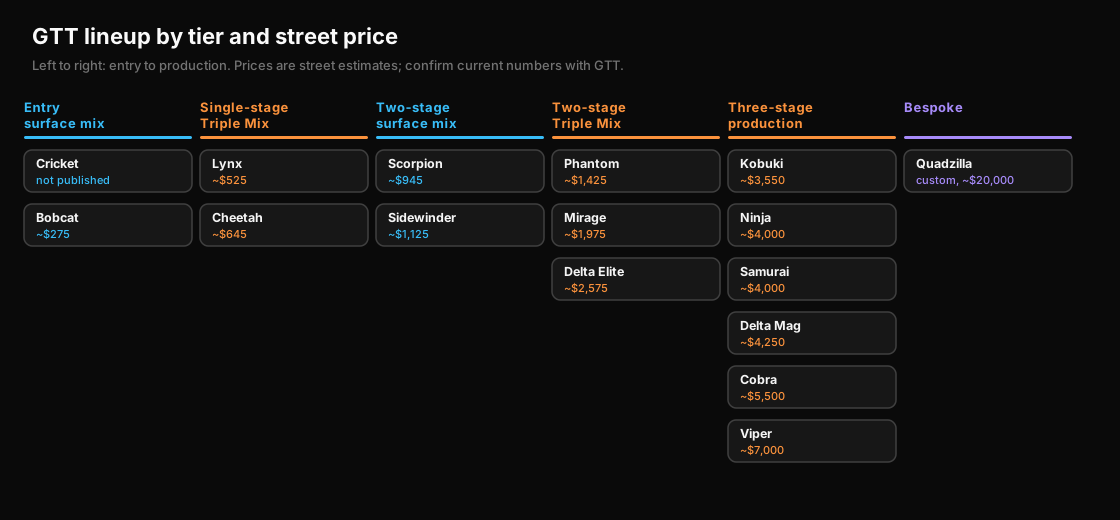
The full GTT lineup
Sixteen models, grouped by burner architecture. Oxygen is the maximum-usable-flame figure in LPM; prices are street estimates.
| Model | Mount | Stages | Jets | Max usable O2 (LPM) | Street price | Best for |
|---|---|---|---|---|---|---|
| Cricket | Bench | 1 | 5 | ~5.5 | Not published | Smallest beads, tight detail, one concentrator |
| Bobcat | Bench | 1 | 7 | ~8.5 | ~$275 | Beginner boro and beads on a single concentrator |
| Lynx | Bench | 1 | 7 | ~9.5 | ~$525 | First Triple Mix; beads and small boro |
| Cheetah | Bench | 1 | 13 | ~13 | ~$645 | Bigger single-stage flame; marbles, small tube |
| Scorpion | Bench | 2 | 13 | ~9.5 | ~$945 | Two-stage surface mix; layered small-to-mid work |
| Sidewinder | Hand or bench | 2 | 22 | ~15 | ~$1,125 | Two-stage surface mix; offhand sculpting |
| Phantom | Bench | 2 | 22 | ~16.5 | ~$1,425 | Two-stage Triple Mix workhorse; pipes, mid boro |
| Mirage | Bench | 2 | 40 | ~26 | ~$1,975 | Larger two-stage Triple Mix; tube, bigger solids |
| Delta Elite | Bench or hand | 2 | 57 | ~30 | ~$2,575 | High-output Triple Mix; bench standard, hand version |
| Kobuki | Bench | 3 | 49 | ~33 | ~$3,550 | Three-stage production Triple Mix |
| Ninja | Bench | 3 | 72 | Not published | ~$4,000 | Three-stage production; large-format boro |
| Samurai | Bench | 3 | 72 | Not published | ~$4,000 | Three-stage production; large-format boro |
| Delta Mag | Bench | 3 | 88 | ~54 | ~$4,250 | High-output three-stage production |
| Cobra | Bench | 3 | 130 | ~65 | ~$5,500 | Very high-output production boro |
| Viper | Bench | 3 | 200 | Not published | ~$7,000 | Top-tier production; largest work |
| Quadzilla | Bench | 4 | Varies | Not published | Built to order | Four-stage, built to order; industrial-scale |
Tier by tier: every model
Entry, standard surface mix. These two are not Triple Mix, and that is fine: they are honest, forgiving starter torches.
Cricket
Price not published · 5 jets · 1 stage · ~5.5 LPM max O2 · standard surface mix
The Cricket is the smallest GTT, a five-jet single-stage surface-mix torch that sips oxygen at roughly 5.5 LPM at full flame, comfortable on a single concentrator. It suits the smallest beads and tight detail work. We do not have a published street price for the Cricket in our catalog, so ask GTT or a source you trust rather than assume one.
Bobcat
~$275 · 7 jets · 1 stage · ~8.5 LPM max O2 · standard surface mix
The Bobcat is the seven-jet single-stage surface-mix torch that GTT built its reputation as a beginner’s boro torch on. At about $275 and a maximum usable flame near 8.5 LPM, it runs on one concentrator and handles beginner boro, beads, and small sculpture without drama.
Single-stage Triple Mix. Triple Mix starts here.
Lynx
~$525 · 7 jets · 1 stage · ~9.5 LPM max O2 · Triple Mix
The Lynx is a seven-jet single-stage Triple Mix torch, similar in size to the Bobcat but running the Triple Mix system and the flame control it is bought for. At roughly $525 and about 9.5 LPM at full flame, it is the natural first step for someone who wants Triple Mix behavior without a two-stage torch’s oxygen appetite.
Cheetah
~$645 · 13 jets · 1 stage · ~13 LPM max O2 · Triple Mix
The Cheetah steps up the flame with thirteen ports total, a three-port center fire inside a ten-port outer ring, still single stage, pulling up to about 13 LPM and costing near $645. It gives you a bigger, hotter single-stage flame for marbles and small tubing while staying inside what a modest oxygen supply can feed.
Two-stage, standard surface mix. Two stages means an independently adjustable outer flame around a center, so you can run a small tight flame or open up a broad bushy one.
Scorpion
~$945 · 13 jets · 2 stages · ~9.5 LPM max O2 · surface mix
The Scorpion is a two-stage surface-mix bench torch at about $945: the five-jet Cricket center fire inside an eight-jet outer, 13 jets in the standard version, with a Lynx-center version (fifteen jets) sold separately. Its maximum usable oxygen is near 9.5 LPM on GTT’s flow chart (GTT’s product page says 11), similar to the Lynx; what the second stage buys here is flame flexibility, the ability to run tight or open, more than raw top-end heat.
Sidewinder
~$1,125 · 22 jets · 2 stages · ~15 LPM max O2 · surface mix (hand or bench)
The Sidewinder is a two-stage surface-mix torch with twenty-two jets, drawing up to about 15 LPM and costing around $1,125, sold as a hand torch or a 2-/4-stud bench setup. In hand-torch form it is aimed at offhand sculpting and work you move around rather than fixed bench production.
Two-stage Triple Mix. This is the heart of GTT’s boro range.
Phantom
~$1,425 · 22 jets · 2 stages · ~16.5 LPM max O2 · Triple Mix
The Phantom is the two-stage Triple Mix workhorse: a Lynx seven-jet center inside a fifteen-jet outer, twenty-two jets in total, up to about 16.5 LPM at full flame, around $1,425. It is the torch a lot of working pipe and boro artists settle on because it covers detail and size in one bench torch.
Mirage
~$1,975 · 40 jets · 2 stages · ~26 LPM max O2 · Triple Mix
The Mirage is the larger sibling: forty jets, up to about 26 LPM, and a Mirage street price around $1,975, made for tube work and bigger solid pieces where the Phantom runs out of headroom.
Delta Elite
~$2,575 · 57 jets · 2 stages · ~30 LPM max O2 · Triple Mix (bench or hand)
The Delta Elite is the high-output member of this group: fifty-seven jets, up to about 30 LPM, near $2,575 for the standard four-stud bench model on GTT’s product page. GTT also sells a separate Delta Elite hand-torch version with its own controls and pricing, which is how many makers know the name: serious heat you can carry to large offhand sculpture.
Three-stage Triple Mix production. These are production burners with a third independently controlled stage, big oxygen demands, and prices to match; plan the oxygen supply before the torch.
Kobuki
~$3,550 · 49 jets · 3 stages · ~33 LPM max O2 · Triple Mix
The Kobuki is the entry to this tier, forty-nine jets and up to about 33 LPM for roughly $3,550.
Ninja
~$4,000 · 72 jets · 3 stages · O2 not published · Triple Mix
The Ninja is a seventy-two-jet three-stage burner at about $4,000. Its maximum usable oxygen is not published in our catalog, so we leave it blank pending GTT documentation rather than invent a figure.
Samurai
~$4,000 · 72 jets · 3 stages · O2 not published · Triple Mix
The Samurai is the Ninja’s seventy-two-jet three-stage counterpart, also about $4,000, and likewise carries no published maximum-usable-oxygen figure in our catalog; we leave it blank pending GTT documentation.
Delta Mag
~$4,250 · 88 jets · 3 stages · ~54 LPM max O2 · Triple Mix
The Delta Mag climbs to eighty-eight jets and up to about 54 LPM for near $4,250.
Cobra
~$5,500 · 130 jets · 3 stages · ~65 LPM max O2 · Triple Mix
The Cobra is a very high-output production torch, one hundred thirty jets and up to about 65 LPM, around $5,500.
Viper
~$7,000 · 200 jets · 3 stages · O2 not published · Triple Mix
The Viper tops the standard line at two hundred jets and roughly $7,000; its maximum usable oxygen is also unpublished in our catalog, pending GTT documentation.
Bespoke.
Quadzilla
Built to order, no published price · jets vary · 4 stages · O2 not published · four-stage
The Quadzilla sits outside the standard catalog: a four-stage torch built to order, with jet count varying by build and oxygen figures unpublished. GTT publishes no price for it, and because it is custom, the only reliable specification and the only reliable price are whatever GTT quotes you for your specific build. Confirm everything directly with the company.
Oxygen and fuel reality for the line
The single biggest planning mistake with GTT torches is buying more torch than your oxygen supply can feed. Because the LPM figures above are maximum-usable-flame ceilings, you do not have to match them, but they tell you how much headroom a torch has and therefore how much oxygen it wants to work comfortably. Our oxygen sizing guide walks through the math in detail; here is the tier-level picture.
The arithmetic is simple: compare a torch’s ceiling to what your supply actually delivers. The entry torches (Cricket at ~5.5 LPM, Bobcat at ~8.5) fit inside a common 5 to 10 LPM concentrator, which is a large part of why the Bobcat is such a common first boro torch; GTT itself points the Bobcat at an economical 5 LPM unit. The Lynx (~9.5) still fits a strong single concentrator, but the Cheetah’s ~13 LPM ceiling already exceeds what most single home units deliver, so its full flame means paired concentrators, a high-output unit, or tanks. The two-stage torches run from ~9.5 LPM (Scorpion) to ~26 and ~30 LPM (Mirage, Delta Elite); at those upper ceilings concentrators alone stop being realistic and compressed or bulk oxygen takes over. The three-stage production torches (~33 to ~65 LPM where published) and the Quadzilla are compressed or bulk oxygen machines outright; no concentrator stack reaches those flow ceilings sensibly.
On fuel, the quarter-psi design point means unboosted household natural gas works across the line, which is unusual and genuinely useful for home studios. Propane works everywhere too. Whatever the fuel, follow GTT’s own pressure and setup instructions for your specific model; those instructions, not this guide, are the authority on your regulator settings.
Which GTT for whom
If you are choosing between two specific GTT models, we have dedicated comparisons that go deeper than this overview:
- First real boro torch, deciding between the two entry paths: the standard-surface-mix Bobcat versus the first Triple Mix Lynx is the core decision. See Lynx vs Bobcat. If you are weighing the Bobcat against a common non-GTT starter, Bobcat vs Nortel Minor covers that cross-shop.
- Stepping up within the single-stage Triple Mix range: the bigger-flame question is Cheetah vs Lynx. If you are comparing the Lynx against a larger non-GTT bench burner, see Lynx vs Nortel Red Max.
- Committing to a two-stage Triple Mix workhorse: the in-house step up is Phantom vs Mirage. Cross-shopping the Phantom against other makers’ torches is common; see Bethlehem Bravo vs GTT Phantom and Carlisle CC vs GTT Phantom.
- Going large in the two-stage range: if you are deciding whether to jump from the Mirage to the high-output Delta Elite, Mirage vs Delta Elite lays out the trade-off.
The general shape of it: beginners and bead makers who want a forgiving torch on one concentrator start at the Bobcat, or the Cricket for the smallest work. Artists who want Triple Mix behavior and reactive-color control step into the Lynx or Cheetah. Working pipe and mid-size boro artists land on the Phantom, moving to the Mirage as their work and oxygen supply grow. Hand-torch sculptors look at the Sidewinder or the higher-output Delta Elite. Production shops with compressed or bulk oxygen scale up through the three-stage burners, and only shops with genuinely industrial needs and budgets reach the Quadzilla.
Related guides
- GTT Triple Mix technology explained
- GTT compressed-air 4-Way Mix
- How many LPM does my torch need?
- GTT Lynx vs Bobcat
- GTT Cheetah vs Lynx
- GTT Phantom vs Mirage
- GTT Mirage vs Delta Elite
- Bethlehem Bravo vs GTT Phantom
- Carlisle CC vs GTT Phantom
- GTT Bobcat vs Nortel Minor
- GTT Lynx vs Nortel Red Max
Sources
- Glass Torch Technologies, company site and standard torch range: https://www.glasstorchtech.com/ and https://www.glasstorchtech.com/standard-torches
- Glass Torch Technologies, Triple Mix torches: https://www.glasstorchtech.com/triple-mix-torches
- Glass Torch Technologies, contact and location (Tioga, PA): https://www.glasstorchtech.com/contact
- Lampwork Etc., “Pre-mix vs Surface mix” (community discussion): http://www.lampworketc.com/forums/showthread.php?t=191042
Editor’s note: model specs, oxygen figures, and prices here are compiled from GTT’s own materials and our catalog (compiled 2026-07-20, not independently re-verified). Prices are street estimates and vary by dealer and by month, several oxygen figures are not yet published by GTT and are left blank rather than guessed, and the maximum-usable-flame LPM numbers are ceilings, not required settings. Confirm current lineup, specs, and pricing with GTT before you buy.